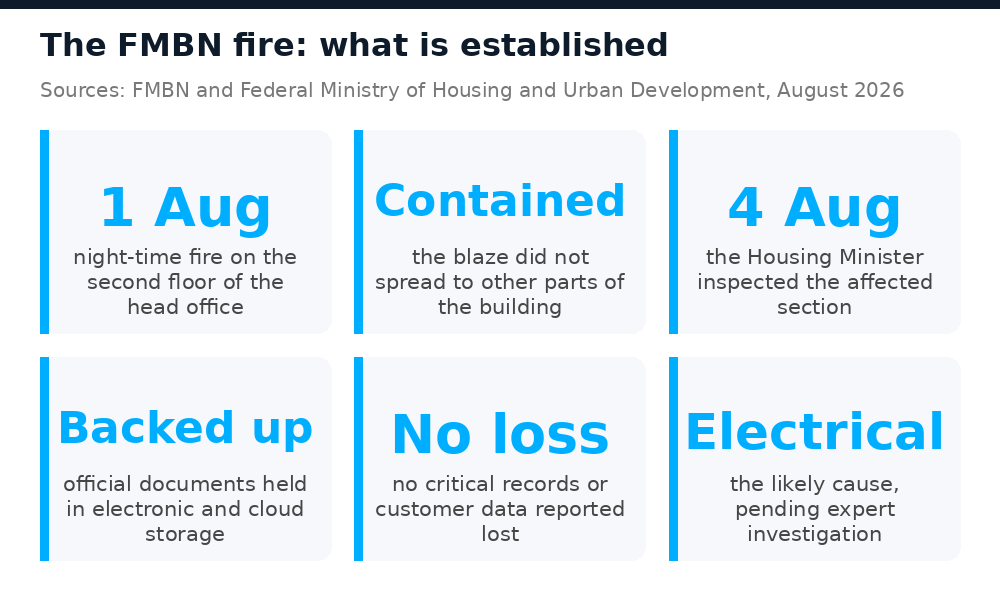
On the night of Saturday 1 August 2026, fire broke out on the second floor of the Federal Mortgage Bank of Nigeria’s head office in Abuja. It was contained and did not spread to other parts of the building. Preliminary findings point to an electrical fault, with expert investigation ongoing.
The reassurance came quickly, and it was specific: according to the Housing Minister, no critical records or customer data were lost, and the official documents affected are securely backed up electronically, including in cloud storage. The bank confirmed its operations remained unaffected. The minister, Engr. Muttaqa Rabe Darma, inspected the affected section on Tuesday 4 August.
So the immediate answer is: your file is fine. But this is a good moment to make a point that has nothing to do with the fire — an institutional backup protects the bank’s version of your record, not the completeness of your contribution history. Those are different things, and the difference is where money gets lost.
Why a backup is not the same as a correct record
A cloud backup faithfully preserves whatever the institution holds. If your file shows eleven years of contributions, the backup preserves eleven years. If it shows eleven years because your employer stopped remitting in year six while continuing to deduct from your salary, the backup preserves that error just as faithfully.
Unremitted deductions are the single most common problem in National Housing Fund participation, and they are invisible from the employee’s side. The deduction appears on the payslip every month. The money simply never arrives. Employees typically discover it years later, at the exact moment they try to draw on the fund — which is the worst possible moment.
No fire is required for this to happen, and no backup fixes it. Only a comparison between your payslips and a contribution statement will reveal it.
How to verify your position
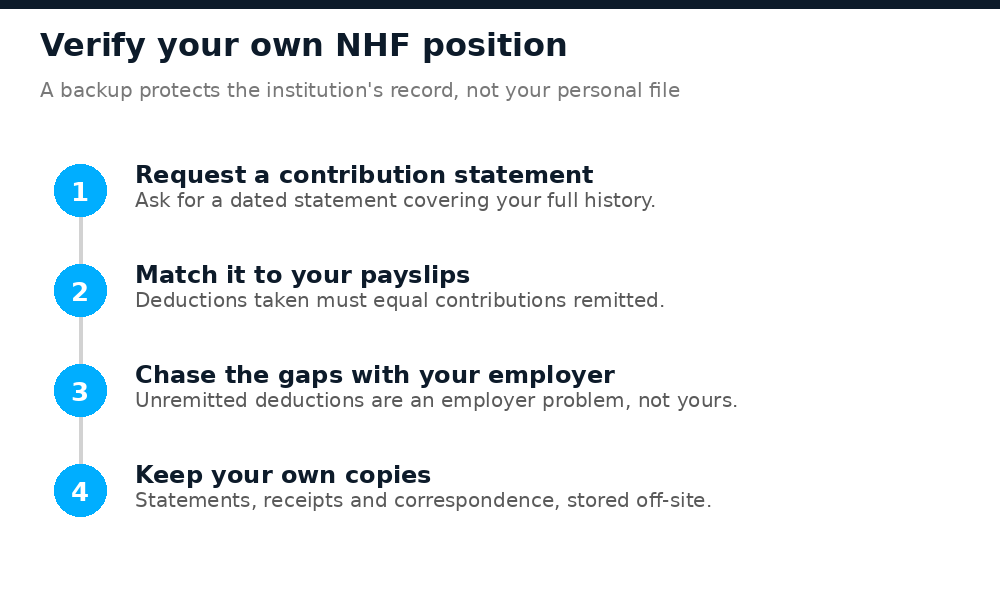
1. Request a dated contribution statement
Ask for a statement covering your full history, not the current year. A partial statement is the most common form of false reassurance: it confirms recent remittance and says nothing about the gap five years back.
2. Match it against your payslips
Line by line, year by year. Every month in which an NHF deduction appears on a payslip should correspond to a contribution received. This is tedious, and it is the entire exercise: the discrepancy, if there is one, will sit in a period you would never have thought to check.
3. Raise gaps with your employer in writing
If deductions were taken but not remitted, that is an employer compliance issue and your payslips are the primary evidence. Put it in writing, keep the correspondence, and give a reasonable deadline. Verbal assurances from a payroll office have the same evidentiary value as verbal assurances anywhere else — none.
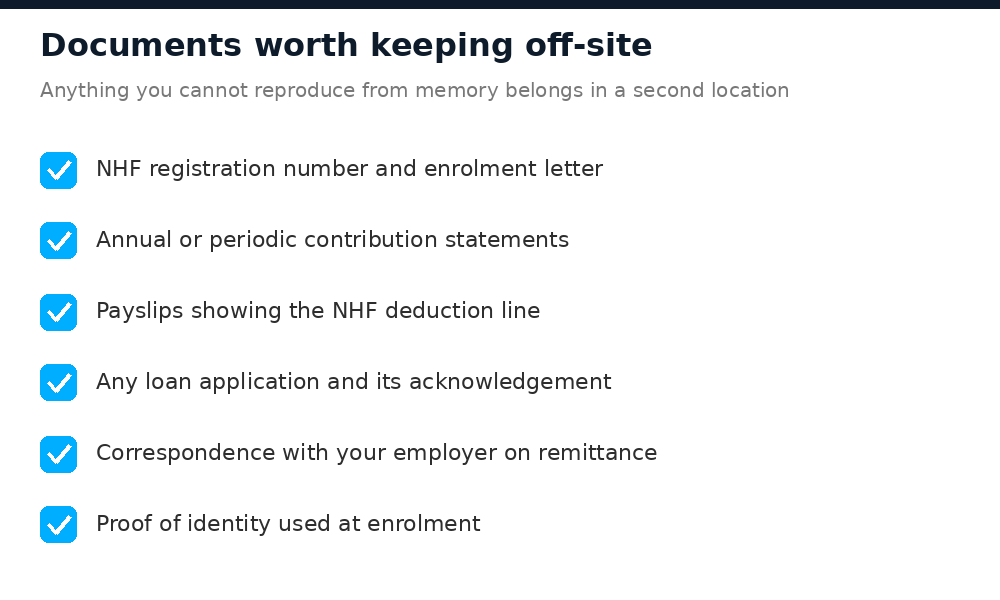
4. Keep your own copies, off-site
Which brings us back to the fire, from the opposite direction. The institution has a cloud backup; most contributors have a single paper folder in one room of one house. If that folder burns, floods, or is simply mislaid during a move, you are entirely dependent on someone else’s records to prove your own position.
The wider context
This matters more than usual right now because the federal housing agenda is expanding. Alongside the proposed national housing regulation policy, the government has announced an increase in the mortgage ceiling to ₦85 million through the FMBN and a target of 2,000 mortgages annually, as we set out in our article on mortgage rates and the interest-free routes that work for most buyers.
Two thousand mortgages a year is a small number against national demand. That scarcity has a practical consequence: when allocation is tight, a clean and complete file is a competitive advantage. An applicant whose contribution history is documented, continuous and verifiable is simply easier to process than one whose record has a four-year hole requiring correspondence with a former employer.
The same logic applies to the broader schemes we have covered, from the Renewed Hope Housing Programme to Lagos State home ownership and rental schemes. Eligibility is checked against documents, and documents are checked long before anyone assesses whether you deserve a house.
What to do this week
- Request your full contribution statement. It costs nothing but a request, and most contributors have never seen one.
- Photograph or scan your key documents and store them somewhere other than your home — an email account to yourself is sufficient, and vastly better than nothing.
- Check three sample years of payslips against the statement. If they match, the odds are the rest does too. If one does not, check them all.
- Note your registration number somewhere you will find it in ten years. A surprising number of disputes begin with a contributor who cannot state their own number.
The fire at the FMBN head office turned out to be, from a customer’s perspective, a non-event: contained, investigated, with records intact. The useful reaction is not anxiety about the institution’s data. It is the simple realisation that most of us keep our own housing paperwork far less carefully than a bank keeps its servers — and that this is entirely within our control to fix.
Frequently asked questions
What happened at the FMBN head office?
A fire broke out on the second floor of the Federal Mortgage Bank of Nigeria’s Abuja head office on the night of Saturday 1 August 2026. It was contained and did not spread to other parts of the building. Preliminary findings point to an electrical fault, with expert investigation ongoing.
Were customer records or NHF contributions lost?
According to the Housing Minister, no critical records or customer data were lost, and the official documents affected are securely backed up electronically, including in cloud storage. The bank also stated that its operations remained unaffected.
Why should I still check my own NHF record?
Because an institutional backup protects the bank’s version of your file, not the completeness of your contribution history. The most common gap is unremitted deductions: money taken from a salary but never forwarded. Only a comparison between payslips and a contribution statement reveals that.
How do I verify my NHF contributions?
Request a dated contribution statement covering your full history, match it line by line against payslips showing the NHF deduction, raise any gap with your employer in writing, and keep your own copies of statements, receipts and correspondence in a second location.
What if my employer deducted but did not remit?
That is an employer compliance issue, not a fault on your side, and your payslips are the primary evidence. Raise it in writing with the employer first, keep the correspondence, and escalate to the fund with your documentation if it is not resolved.