Anyone who has bought a Nigerian property off-plan knows the moment: you transfer the first instalment, and from that point the money is gone into a company you cannot audit, backing a building you cannot inspect. If the developer stalls, your recourse is goodwill and litigation — in that order.
That is the problem the Federal Government now says it wants to fix. Speaking at the BusinessDay Abuja Real Estate Conference 2026, the Minister of Housing and Urban Development, Engr. Muttaqha Rabe Darma, set out a national housing regulation policy built on developer licensing and escrow protection for buyers’ funds.
One caveat first, because it governs everything else: this is a draft. The ministry is still developing the framework, with a stakeholder engagement process announced for the following week. Nothing in it binds anyone today.
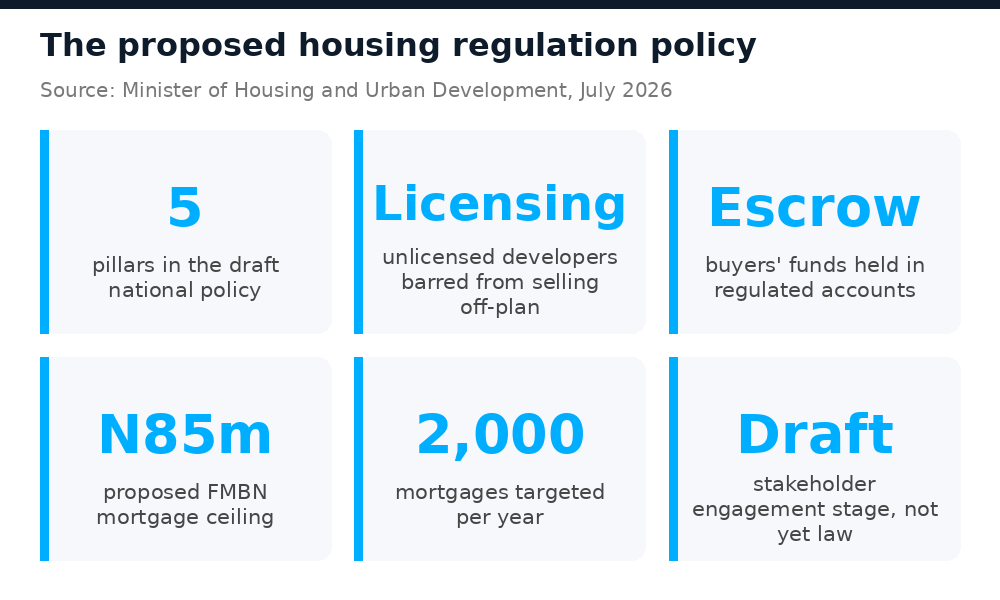
The five pillars
1. Developer licensing
The stated aim is to prevent unlicensed developers from selling off-plan properties. This is the structural fix: today, anyone with a signboard and a layout drawing can take deposits. Licensing creates a gate, and — more importantly — something to revoke.
2. Escrow protection
Buyers’ funds would sit in regulated accounts rather than in the developer’s general working capital. It is the single most consequential provision for anyone buying before completion, and we come back to it below.
3. Construction quality assurance
Standards oversight on building projects. Licensing without inspection would simply produce licensed developers building badly, so the two belong together.
4. Professional registration
Credentialing requirements for industry participants — the same logic Lagos has been pursuing separately through agent registration, which we covered in our piece on the Lagos Tenancy Bill’s agent registration and 5% fee cap.
5. A National Housing Industry Data Observatory
A tracking mechanism for sector transparency. Less headline-grabbing than escrow, but arguably more durable: policy without data tends to be rewritten every few years on anecdote.
What else was announced
Alongside the regulation policy, the minister set out several measures: a mortgage loan ceiling raised to N85 million through the Federal Mortgage Bank of Nigeria, a target of 2,000 mortgages annually, a National Rent Registry with tenancy regulations, the Land4Growth initiative, and an e-Certificate of Occupancy programme.
Two of these deserve a reality check. A target of 2,000 mortgages a year is meaningful for those who obtain one, but it is a rounding error against national demand — which is exactly why we keep pointing readers toward the alternatives set out in our article on mortgage rates and the interest-free routes that work. And an e-Certificate of Occupancy programme only matters if it reaches state land registries, where the actual bottleneck sits.
Escrow: what it would fix, and what it would not
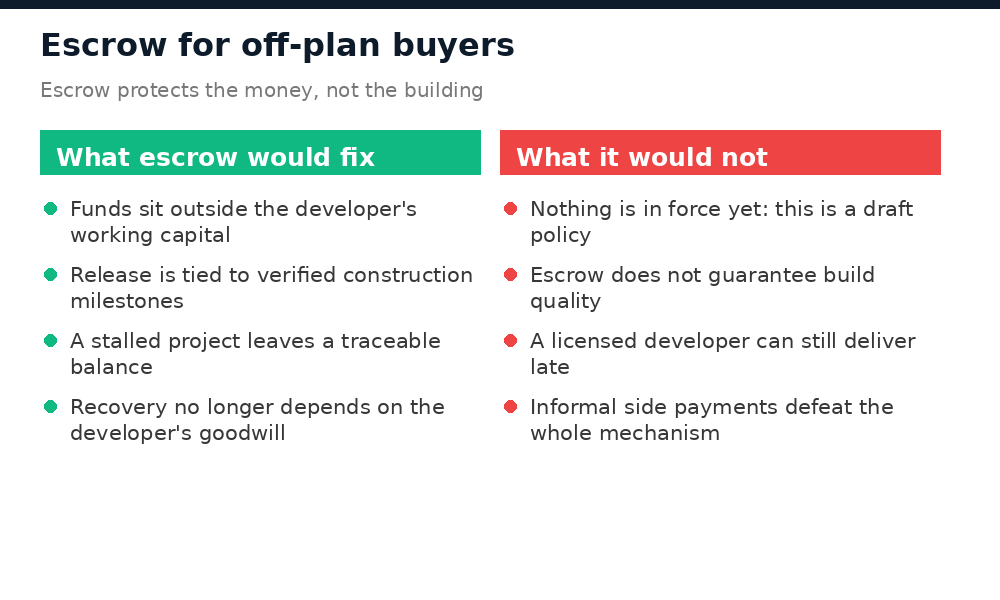
What it fixes
- Your money stops funding the developer’s other projects. The classic Nigerian off-plan failure is not fraud in the criminal sense — it is cross-subsidy. Deposits on Phase 3 finish Phase 1, and when sales slow, the last cohort of buyers carries the loss.
- Release is tied to verified milestones, which converts a promise into a measurable event.
- A stalled project leaves a traceable balance rather than an empty account and a company with no assets.
- Recovery stops depending on goodwill, which is the current position and a poor one.
What it does not fix
- It is not in force. Worth repeating, because “there’s escrow coming” is already being used as a sales argument.
- It does not guarantee build quality. Money released against a completed slab says nothing about the slab.
- A licensed developer can still deliver two years late. Licensing filters out the worst actors; it does not create competence.
- Informal side payments defeat the mechanism entirely. Any amount paid outside the regulated account is unprotected, whatever the discount offered for paying that way.
What to demand today, before any of this is law
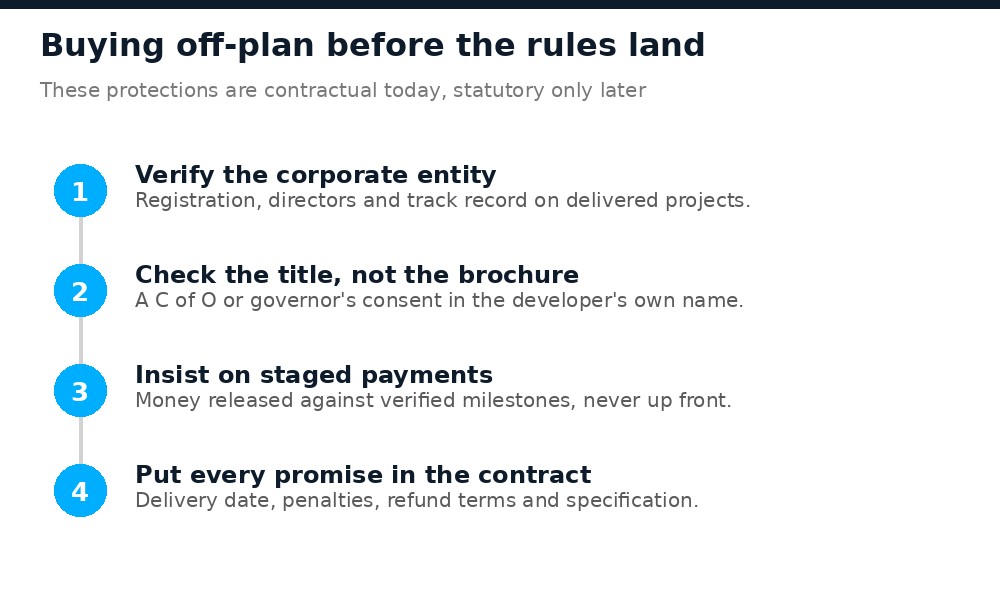
Every protection in the draft policy can be replicated contractually right now. That is the practical takeaway: you do not have to wait for the law to get most of its benefit.
Verify the corporate entity, not the brand
Check registration, directors, and — above all — the record on delivered projects, not announced ones. Visit a completed estate from the same developer and speak to residents. A brochure tells you about ambition; a three-year-old estate tells you about execution. Our guide on choosing an agent and avoiding quacks applies equally to developers.
Check the title, in the developer’s own name
A Certificate of Occupancy or governor’s consent held by the developer, verified independently. Not “title in process”, not a deed of assignment from an unverified vendor. Our article on land title verification in Lagos sets out how, and our piece on the Lagos illegal estates list shows what happens when this step is skipped.
Insist on staged payments
This is a private escrow in all but name. Tie each instalment to a verifiable physical milestone — foundation, decking, roofing, finishing — and inspect before releasing. A developer confident of delivery has no reason to refuse; one who insists on full payment up front is telling you something.
Put every promise in the contract
Delivery date, penalty for late delivery, refund terms if the project is abandoned, and the full specification down to fittings. Verbal assurances from a sales agent have no value. If it matters to you, it belongs in the document you sign.
The bottom line
The proposed policy is the right diagnosis. Nigerians lose life savings to unlicensed developers precisely because buyers remain unprotected in the absence of escrow arrangements and other regulatory safeguards, and a housing sector that contributes at this scale to the economy cannot run indefinitely on trust.
But a policy in stakeholder consultation is not protection. Until it is law and enforced, the burden sits where it has always sat: on the buyer’s due diligence and on what is written into the contract. The good news is that the draft is effectively a checklist of what to negotiate for — and it is available to anyone willing to insist on it today.
Frequently asked questions
What is Nigeria’s proposed national housing regulation policy?
A draft policy announced by the Minister of Housing and Urban Development, Engr. Muttaqha Rabe Darma, at the BusinessDay Abuja Real Estate Conference 2026. It sets out five components: developer licensing, escrow protection for buyers’ funds, construction quality assurance, professional registration, and a National Housing Industry Data Observatory.
Is the policy already in force?
No. The ministry is still developing the framework and a stakeholder engagement process on the proposed reforms was announced for the following week. Until it is enacted, nothing in it binds a developer, and buyers have to secure equivalent protections in their own contracts.
What would escrow actually protect?
It would keep a buyer’s instalments outside the developer’s working capital, with release tied to verified construction milestones. If a project stalls, there is a traceable balance rather than money already spent elsewhere. Escrow protects the money — it does not guarantee build quality or delivery on time.
What else was announced alongside the policy?
An increase in the mortgage loan ceiling to ₦85 million through the Federal Mortgage Bank of Nigeria, a target of 2,000 mortgages annually, a National Rent Registry with tenancy regulations, the Land4Growth initiative and an e-Certificate of Occupancy programme.
What should I check before buying off-plan today?
Verify the developer’s corporate registration, directors and record on completed projects; confirm the title is a C of O or governor’s consent held in the developer’s own name; insist on staged payments released against verified milestones; and write every promise — delivery date, penalties, refund terms, specification — into the contract itself.