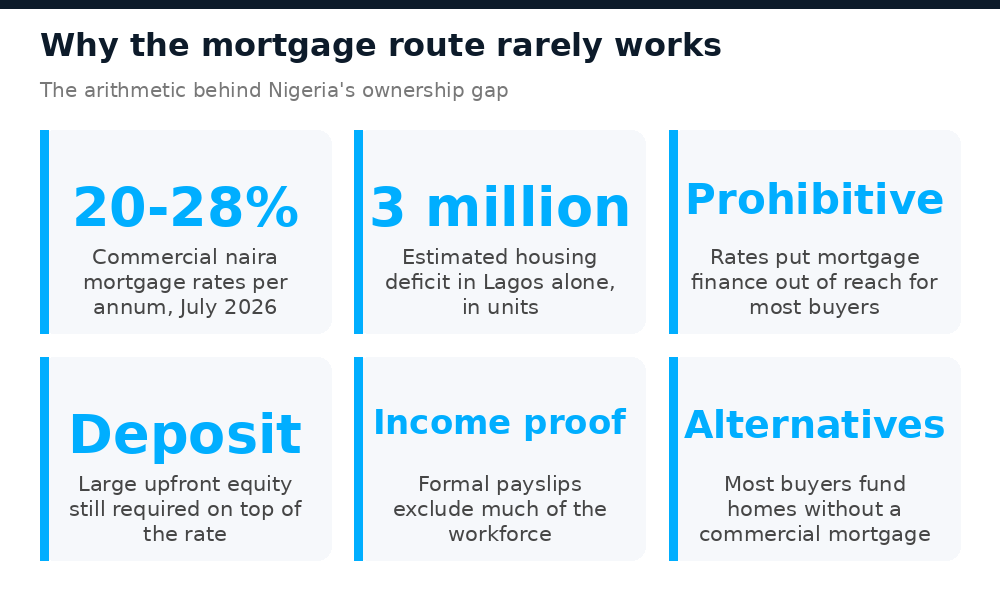
Ask most Nigerians how they plan to own a home and very few will say “a mortgage”. The reason shows up plainly in the numbers: as of July 2026, commercial naira mortgages run at 20-28% per annum. At those rates, mortgage financing is prohibitively expensive for the overwhelming majority of buyers — before you even reach the equity deposit and the formal income documentation that lenders require.
Meanwhile the need has never been greater: Lagos alone carries an estimated housing deficit of around 3 million units, the result of decades in which supply failed to keep pace with urbanisation.
So how do people actually become owners? Through routes that avoid interest-bearing credit altogether. Each works — and each has a specific failure mode you need to know about.
Route 1: Building in stages
The most widely used path, and the most misunderstood. Rather than borrowing the full cost, you buy land, then build in phases as funds allow: foundation, then walls and roof, then one habitable room, then progressive completion.
Its great strength is that you never owe anyone anything. Its weakness is exposure over time: an unfinished structure standing for years is vulnerable to weather, theft of materials, encroachment and, above all, cost inflation between phases.
Two rules make it work. First, secure the land completely before laying a block — title, survey, and confirmation the plot is not on a contested or unapproved layout. Second, reach a lockable, roofed, habitable state as early as possible, even if small. A roofed structure you can occupy or let stops the bleeding; an open foundation only costs money.
Route 2: Cooperatives and contribution schemes
Cooperative societies and esusu-type contribution schemes pool members’ money so that each in turn receives a lump sum large enough to buy land or fund construction. Well run, they are extremely effective: they impose savings discipline, they aggregate purchasing power for bulk land acquisition, and they carry no interest burden.
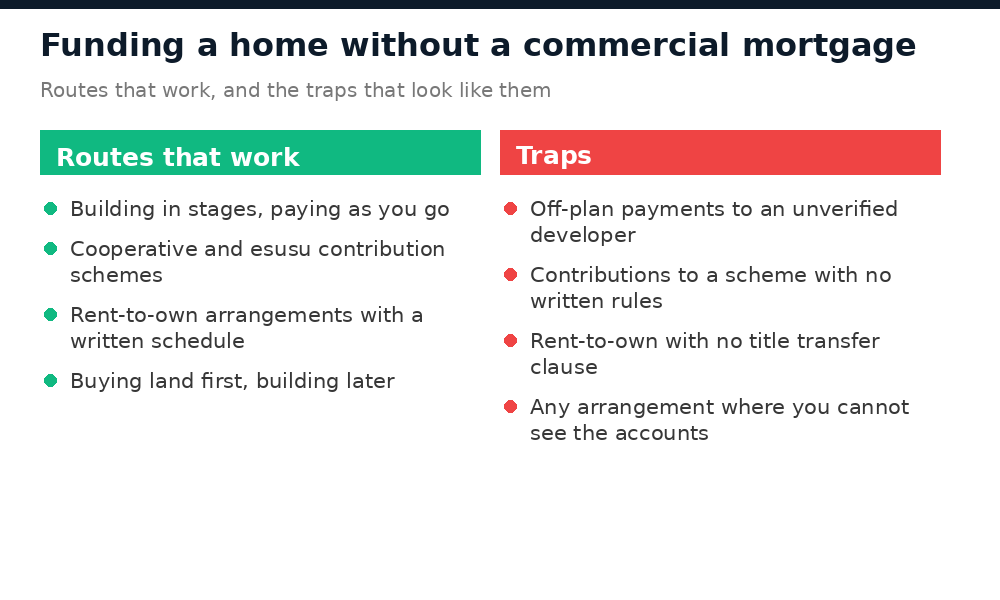
Badly run, they are how people lose years of savings. The difference is almost always governance and documentation, not the good intentions of the organisers.
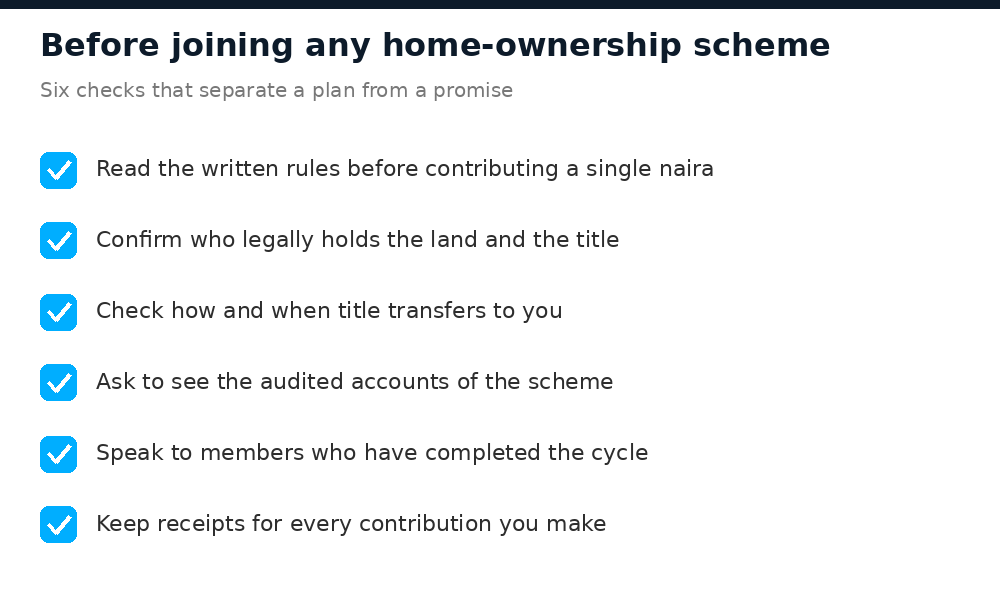
The question that matters most is the one people ask last: who legally holds the title, and at what point does it transfer to me? A scheme where land sits indefinitely in the name of the society or of an individual officer, with no documented transfer mechanism, is a scheme where your contribution buys a promise rather than a property.
Route 3: Rent-to-own
Here you occupy the property while payments accumulate towards ownership. It solves the biggest practical problem of the staged route — you have somewhere to live throughout — and it converts rent, otherwise a pure expense, into equity.
The critical clause is what happens to your accumulated payments if you default or if the seller walks away. In a weak agreement, everything you have paid is treated as rent and simply disappears. Insist that the contract states the payment schedule, the exact point at which title transfers, what happens on missed payments, and what happens if the seller defaults or dies. Have a lawyer read it before signing — the cost is trivial against what is at stake.
The trap that mimics all three
One warning applies across every route: off-plan payments to a developer you have not verified. It looks like staged building (you pay progressively), it looks like a scheme (many buyers together), and it can be entirely legitimate — or it can be a hole in the ground that never becomes anything.
Before any payment, verify the developer’s completed projects on the ground, confirm the land title behind the scheme is in the developer’s name, and structure payments against verified construction milestones rather than calendar dates.
If your interest is returns rather than a place to live, note that property exposure does not require buying a house at all — we covered that in our article on investing in property through REITs.
Know what you are actually building
Whichever route you choose, budget from real construction figures rather than optimistic estimates. We broke down the current cost base in our article on what it really costs to build a three-bedroom bungalow in Nigeria in 2026. Underestimating this is the single most common reason staged builds stall halfway.
Frequently asked questions
What are mortgage rates in Nigeria in 2026?
Commercial naira mortgages run at 20-28% per annum as of July 2026. At those levels, mortgage financing is prohibitively expensive for most buyers.
How do most Nigerians fund a home instead?
Mainly through staged self-building, cooperative and esusu-type contribution schemes, and rent-to-own arrangements — routes that avoid interest-bearing credit.
What is the main risk of building in stages?
Time exposure: an unfinished structure is vulnerable to weather, theft of materials, encroachment and cost inflation between phases. Reaching a roofed, lockable state early is what limits that risk.
How do I judge whether a cooperative scheme is safe?
Read the written rules before contributing, confirm who legally holds the land and title, check exactly how and when title transfers to you, ask to see audited accounts, and speak to members who have completed a full cycle.
What must a rent-to-own contract state?
The payment schedule, the precise point at which title transfers, what happens to accumulated payments if you miss payments, and what happens if the seller defaults or dies. Have a lawyer review it before signing.
Is buying off-plan a safe alternative?
Only with a verified developer. Inspect completed projects on the ground, confirm the land title is in the developer’s name, and tie payments to verified construction milestones rather than calendar dates.
The takeaway
At 20-28%, a commercial mortgage is not a realistic route for most Nigerian buyers, and treating it as the default is what leaves people renting indefinitely. The workable paths are staged building, cooperative contribution and rent-to-own — provided you secure title first, insist on written rules and transfer mechanics, and keep a receipt for every naira you put in.