For decades, renting in Lagos meant one brutal sentence: one year upfront, plus agency, plus legal, plus caution. For a household earning monthly, that is close to impossible without borrowing from family. So it is no surprise that rent-now-pay-later and monthly rent plans have become one of the most discussed housing products of 2026.
The pitch is genuinely attractive: move in now, pay as you earn. The question this article answers is narrower and more useful — what does it actually cost you over twelve months, and how do you tell a fair offer from an expensive one?
How these schemes are structured
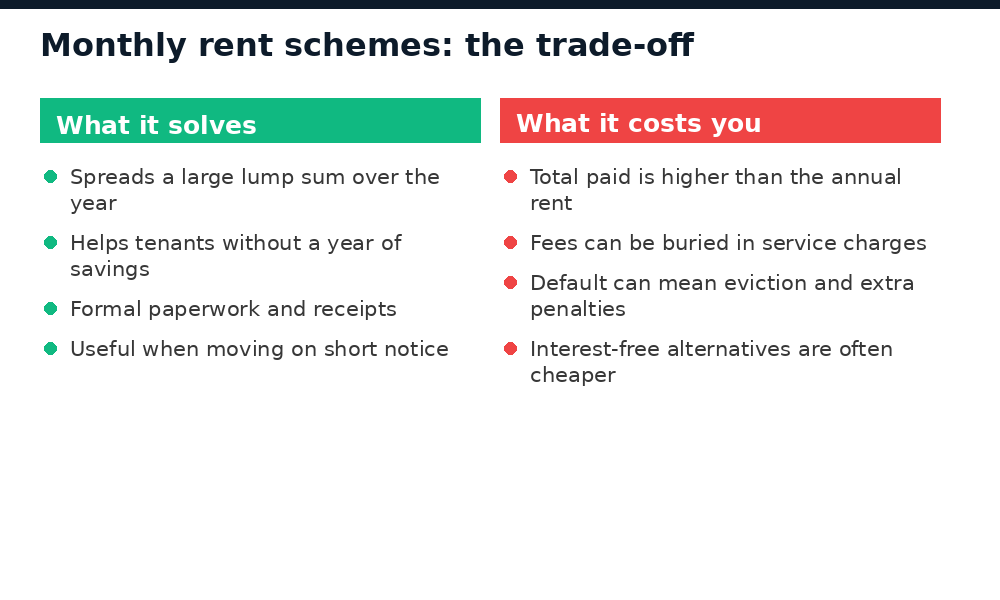
Under the hood, most offers work the same way. A third party — a fintech, a property platform, sometimes the landlord’s agent — pays the landlord the annual rent upfront. You then repay that party in monthly or quarterly instalments, plus a charge. That charge may be called a service fee, a processing fee, a convenience fee or interest, but economically it plays the same role.
Two structural points matter more than the branding. First, you are usually not dealing with your landlord any more for the money side — a separate agreement now governs your payments. Second, missing an instalment is not simply a late rent problem; it can trigger penalties under that second agreement and put your tenancy at risk.
Work out the real annual cost, in five minutes
Forget percentages quoted in the brochure. Do this instead:
- Write down the annual rent the landlord would accept if you paid upfront.
- Add up every single payment you will make to the scheme over twelve months — instalments, upfront fee, insurance, processing, late-payment buffers.
- Subtract the first from the second. That difference is the true cost of spreading your rent.
- Divide it by the annual rent to get the real premium as a percentage.
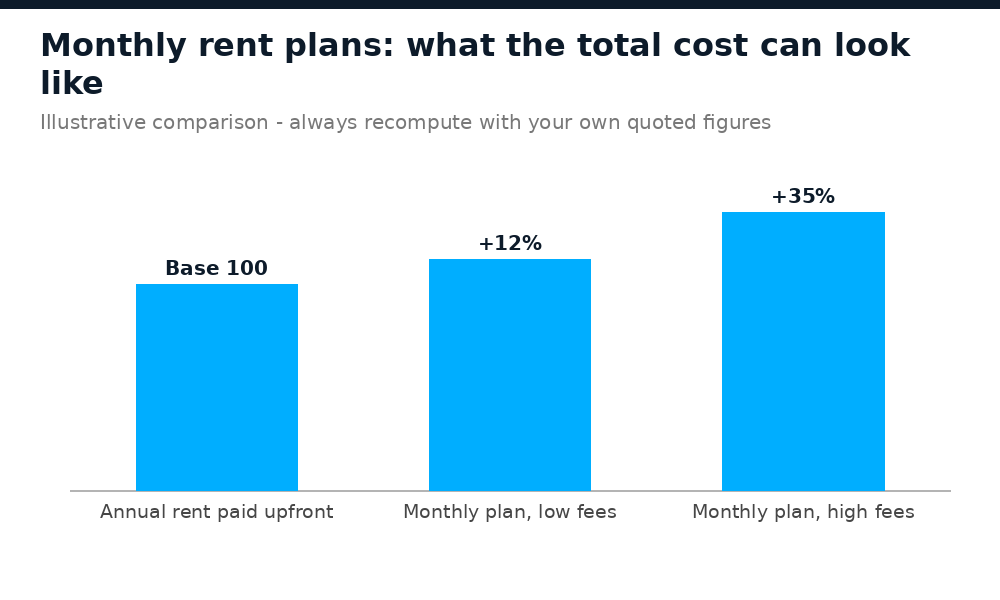
Realistic offers in the market sit anywhere from roughly a tenth to a third above the upfront price once every fee is counted. A scheme that adds a modest premium and buys you a year of cash-flow breathing space can be a rational trade. A scheme that adds a third is a very expensive way to solve a savings problem.
What to check before you sign
- Is the total repayable stated in naira? Not a rate, not a monthly figure — the full amount. If the provider will not put it in writing, that is your answer.
- Who holds the tenancy? You should still be the tenant on a tenancy agreement with the landlord. Be careful with structures where the provider becomes the tenant and you become a licensee — your security of occupation is weaker.
- What happens if you miss one instalment? Ask for the penalty in figures, and for the number of missed payments that triggers action.
- Can you exit early? If you settle the balance in month seven, do the remaining fees disappear or not?
- Are agency and legal fees inside or outside the plan? Under the Lagos tenancy reforms now moving through the House of Assembly, agent registration and a cap on agency fees are squarely on the table — do not accept an unexplained “agency” line, and always ask for a receipt.
- Is the rent advance itself lawful? Lagos rules restrict how much advance can be demanded. A scheme should not be used to quietly reintroduce a demand the law limits.
The interest-free alternatives worth comparing
Before committing to a paid instalment product, price these first. In many cases one of them costs nothing at all:
- Negotiating directly with the landlord. More landlords than tenants expect will accept two or three instalments, especially for a tenant with a clean record. Ask before you assume. Put the schedule in the tenancy agreement.
- Employer rent schemes. Many mid-size and large employers advance rent and recover it from salary at no charge. It is under-used simply because people do not ask HR.
- Cooperatives and staff multipurpose societies. Contribution-based, no interest in many structures, and the paperwork is straightforward.
- Save-first with a shorter lease. A slightly smaller unit for one year, while you build the upfront amount, often beats paying a third extra to stay in a unit you cannot yet afford.
- Rent relief under the 2026 tax rules. If you are eligible, the deduction reduces your taxable income and improves your effective rent burden — worth factoring into the comparison.
When a monthly plan genuinely makes sense
This is not an argument against these products. A monthly plan is a reasonable choice when you are relocating at short notice for a job, when your income is monthly and stable, when the premium is at the lower end, and when the alternative is an expensive informal loan. It is a poor choice when you are already stretched, when the premium is high, or when you are using it to rent above your means.
The honest test: if your income fell by twenty per cent, could you still make every instalment? If the answer is no, the scheme is not solving your problem — it is postponing it.
Frequently Asked Questions
Is rent-now-pay-later the same as a loan?
Economically, yes: a third party pays your rent and you repay over time with a charge attached. The label varies — service fee, convenience fee, processing fee — but you should evaluate it exactly as you would a loan, by working out the total naira amount repayable against the upfront rent.
Can my landlord evict me if I miss an instalment?
It depends on how the agreements are structured. If the provider has already paid your landlord, your immediate exposure is to the provider under the finance agreement — but many arrangements link the two, and a default can ultimately put your occupation at risk. Ask specifically what a missed payment triggers, and get the answer in writing.
How much rent advance can a landlord legally demand in Lagos?
Lagos rules limit the advance that may be demanded, and further tenancy reforms addressing agency charges and arbitrary increases are progressing through the state legislature. Do not accept a demand for a year or more upfront as though it were simply “how things are done” — ask for the demand in writing and keep it.
Does using a monthly plan build any credit history?
Some providers report repayment behaviour, others do not. If building a record matters to you, ask explicitly whether repayments are reported and to which bureau — and be aware that this cuts both ways if you default.
What is the cheapest way to rent in Lagos if I have no savings?
In most cases: negotiate an instalment schedule directly with the landlord, or use an employer or cooperative scheme, and rent a smaller unit for one year while you build the upfront amount. Paid instalment products are best treated as a fallback, not the default.