Ask a Lagos buyer why a land purchase went wrong and you will usually hear about the seller: the wrong family member, a second sale, a forged document. Those things happen. But the largest category of loss is quieter and far more avoidable.
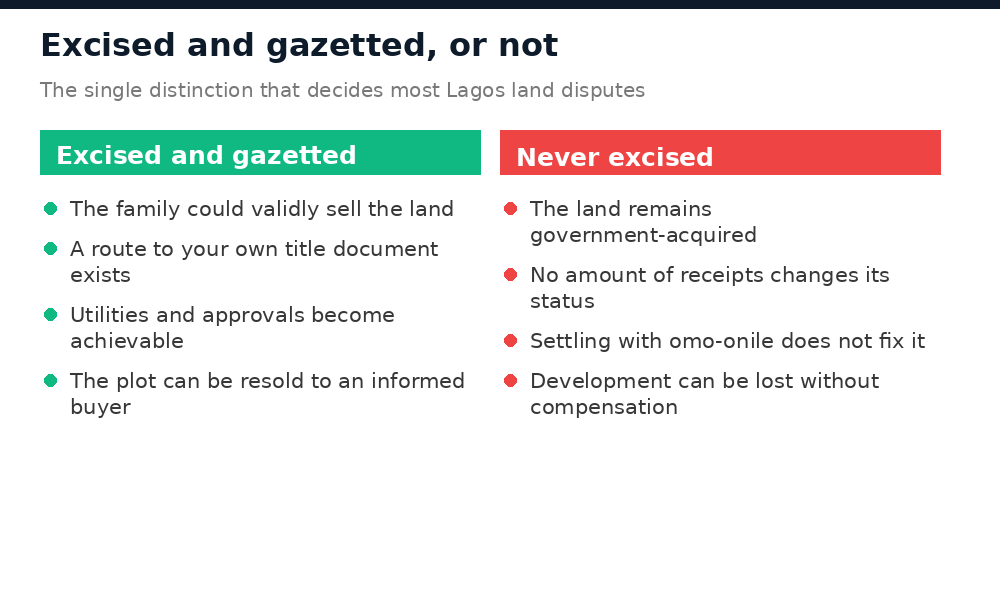
It is this: the land was never the family’s to sell in the first place, because the government had acquired it and never released it. Excision and gazette are the two words that answer that question — and most buyers meet them only after the money is gone.
Where government acquisition comes from
Large areas of land in and around Lagos and Ogun were acquired by government for public purposes. Acquisition does not require the land to be fenced, developed or even visited. A community can continue farming, building and selling on land that is, on the government’s records, already acquired.
That gap between what you see on the ground and what the records say is where buyers get hurt. The village is real, the family is real, the receipt is real — and none of it makes the sale valid.
Excision: the release
Excision is the act of carving a portion of acquired land back out and returning it to the indigenous community. Once a village’s land has been excised, that community can legitimately deal with it: sell it, allocate it, develop it.
Excision is granted for a defined area, not for a family name. This matters more than it sounds. A family may hold a genuine excision over one block, and be selling you a plot that sits outside it. The excision covers ground, not people.
Gazette: the proof
The gazette is the official government publication in which the excision is recorded — typically naming the village, the area released and the relevant plan number. It is what turns a claim into a verifiable fact.
This is the distinction to hold onto:
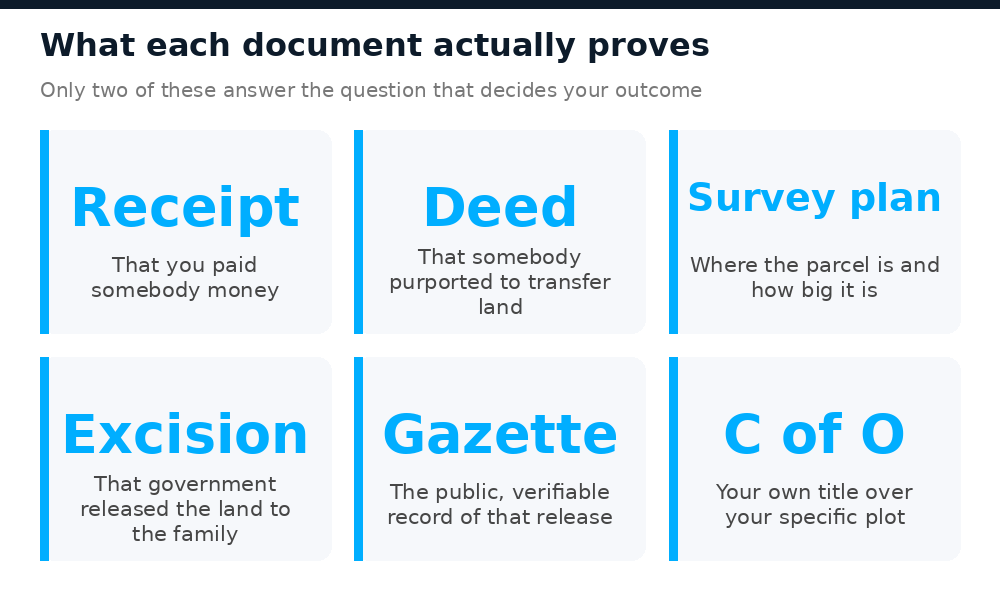
- A receipt proves that you paid somebody money.
- A deed proves that somebody purported to transfer land to you.
- A survey plan proves where the parcel is and how big it is.
- The gazette proves that the land was the family’s to transfer at all.
Only the last one answers the question that actually decides your outcome.
Why the survey plan misleads so many buyers
A survey plan is a technical document. It gives coordinates, beacon numbers, dimensions and the surveyor’s details. It is genuinely necessary — you cannot lodge a search without it.
But it is descriptive, not permissive. A perfectly valid survey plan can describe land that is entirely under government acquisition. Buyers routinely treat the plan as a clearance because it looks official, carries a stamp and costs money. It clears nothing.
The same confusion appears with allocation papers, deeds of assignment and family receipts. All of them describe a transaction; none of them describe the land’s status with government.
How to actually check, before you pay
The check is not complicated, and it is not expensive relative to what is at stake.
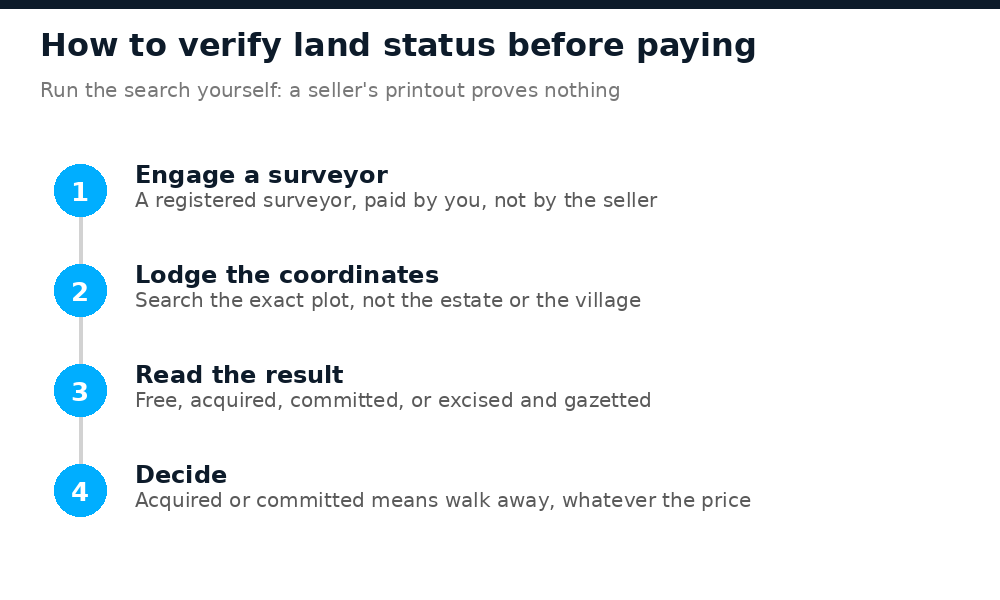
Engage a registered surveyor and have the survey coordinates lodged with the state lands bureau for a search. The result tells you which of four situations you are in:
- Free from acquisition — the cleanest outcome.
- Under government acquisition — walk away, whatever the price.
- Committed to a scheme or purpose — the land is earmarked; treat as acquired.
- Excised and gazetted — the land was validly released; proceed with the remaining checks.
Two practical rules. Pay the surveyor to run the search yourself, rather than accepting a printout the seller produces — that document is trivially easy to fabricate and impossible for you to verify. And search the coordinates of the exact plot, not the estate or the village generally.
Where Ogun differs in practice
The commuter belt around Lagos has pushed enormous demand into Ogun, and with it a large market in plots sold by families and small “estates”. The legal principle is the same, but two habits are worth adding.
First, check whether the layout itself has any approval, and not merely whether the land is excised — an unapproved layout on excised land still creates problems for utilities, access roads and resale. Second, be sceptical of estates that market heavily on price and proximity while staying vague about documentation. The pattern is described in Is Your Estate on Lagos State’s Illegal List?, and it applies across the state line.
What excision does not give you
A gazette is not a Certificate of Occupancy. It establishes that the community held the land validly; it does not, by itself, give you personal title over your plot.
Think of it as the difference between a road being open and your having arrived. Gazetted land puts you on a route that leads to a title document; unexcised land puts you on no route at all. The title side of the journey is covered in Land Title Verification in Lagos and How to buy land safely in Nigeria.
The omo-onile question
Buyers often assume that settling with the omo-onile resolves everything. It resolves one thing: your immediate ability to work on the site without interference.
It does not convert unexcised land into excised land, and it does not bind government. Paying development levies on land under acquisition means paying for peace on a plot you may still lose. Handle the two issues separately, and settle the excision question first.
The bottom line
Before price, before location, before the estate’s brochure, ask one question: has this land been excised, and can the gazette be produced and verified? If the answer is vague, the answer is no.
Everything else — survey, deed, receipts, agent — describes a transaction. Only excision and gazette tell you whether there was anything to transact.
Frequently Asked Questions
What does excision actually mean?
Excision is the process by which the state government releases a portion of land back to the indigenous community that occupied it, carving it out of land the government had earlier acquired. Once excised, that portion can legitimately be sold by the family. Land that has never been excised remains government-acquired, no matter how many generations of the family have farmed it.
What is a gazette, and why does it matter more than a receipt?
The gazette is the official government publication that records the excision — the village, the surveyed area and the plan number. It is the public, verifiable record that the release actually happened. A receipt from a family only proves you paid somebody; the gazette proves the land was theirs to sell.
Is a survey plan proof that my land is safe?
No. A survey plan describes a parcel: its coordinates, its size, its beacons. It says nothing about whether the government has released that parcel or has acquired it for a public purpose. This is the single most common misunderstanding among Lagos and Ogun buyers — a perfectly valid survey can describe land that is entirely under government acquisition.
How do I check whether land is excised or under acquisition?
Have a registered surveyor lodge the survey coordinates with the state lands bureau for a search. The search reveals the land’s status: free, under government acquisition, committed to a scheme, or excised and gazetted. Do this before you pay, not after — and pay the surveyor for the search rather than relying on a document the seller hands you.
Can I get a Certificate of Occupancy on gazetted land?
Gazetted excision is the normal route to regularising title on family land, but the gazette itself is not a C of O. It establishes that the land was validly released; you then pursue your own title document over your specific parcel. Buying gazetted land puts you on a path that leads somewhere — buying unexcised land does not.