
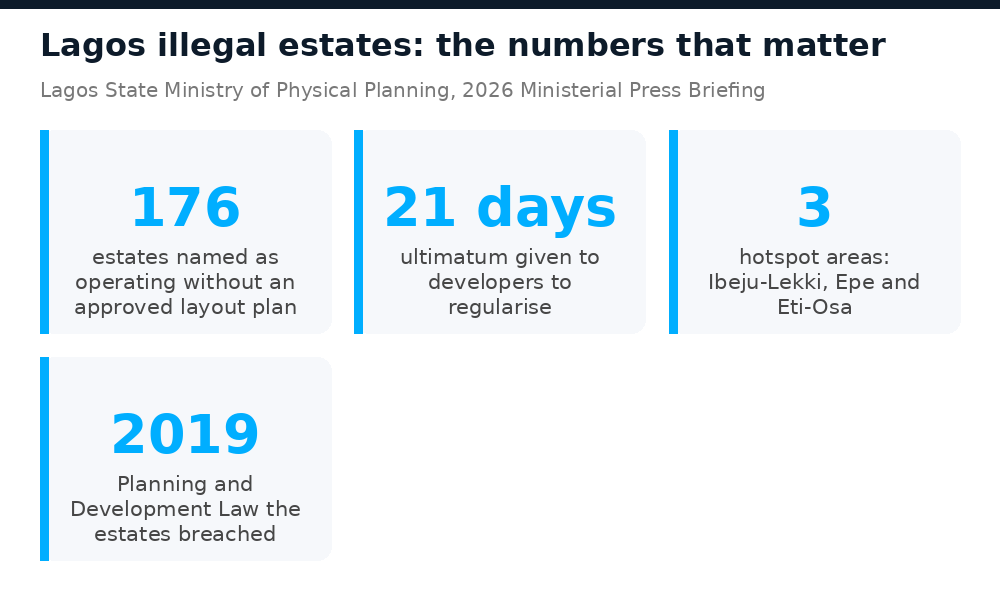
If you are about to pay for a plot in a Lagos estate, there is a check most buyers skip — and it has nothing to do with whether the land documents look convincing. Lagos State has published a list of 176 estates operating without an approved layout plan, and enforcement has been tightening through July 2026. The uncomfortable part for buyers is that in these cases the seller is usually a registered developer, and the paperwork you are handed may be perfectly real. The defect sits somewhere else entirely.
What exactly did Lagos State publish?
The state named 176 estates it says are operating without approved layout plans, disclosed by the Commissioner for Physical Planning at the 2026 Ministerial Press Briefing. Developers were given a 21-day ultimatum to regularise their schemes. The law in question is the Lagos State Urban and Regional Planning and Development Law, 2019, and the state has been explicit that estates which stay outside it face “sanctions, demolition, and prosecution”.
That last phrase is what should concentrate a buyer’s mind. Sanctions land on the developer. Demolition lands on whatever has been built. But the person holding a plot inside the scheme is the one carrying the loss.
Why does a layout plan matter if my documents look fine?
Because a layout approval and a land title answer two completely different questions. A title asks who owns this land. A layout approval asks whether this land may lawfully be cut into plots and built on in the way the developer is selling it.
An estate can sit on land the developer genuinely owns, with a genuine root of title, and still have no approved layout — because the subdivision, the road widths, the drainage provision, the setbacks and the proportion of the site given to infrastructure were never signed off by the planning authority. You can buy a real plot, from a real owner, inside a scheme that was never approved to exist in that shape.
This is why the usual due diligence advice only takes you halfway. Verifying a title protects you against selling by someone who does not own the land. It does not tell you whether the estate layout itself is approved. Two separate checks, two separate offices, two separate risks.
Which areas are most affected?
The flagged estates are concentrated in Ibeju-Lekki, Epe and Eti-Osa — precisely the corridor that has seen the fastest plot-selling activity and the most aggressive marketing. That concentration is not a coincidence. Where demand runs ahead of approvals, schemes get launched and sold before the planning file is complete, on the assumption that regularisation will catch up later. Sometimes it does. The 176 names are the cases where it did not.
If your plot is anywhere along that axis, treat the layout check as mandatory rather than optional.
Do approvals actually get refused?
Yes, and the gap between applications and approvals is where unapproved schemes come from. Lagos State received 14,549 planning permit applications between June and December 2025 and granted 11,701. Between January and March 2026 it received 7,054 and granted 5,578.
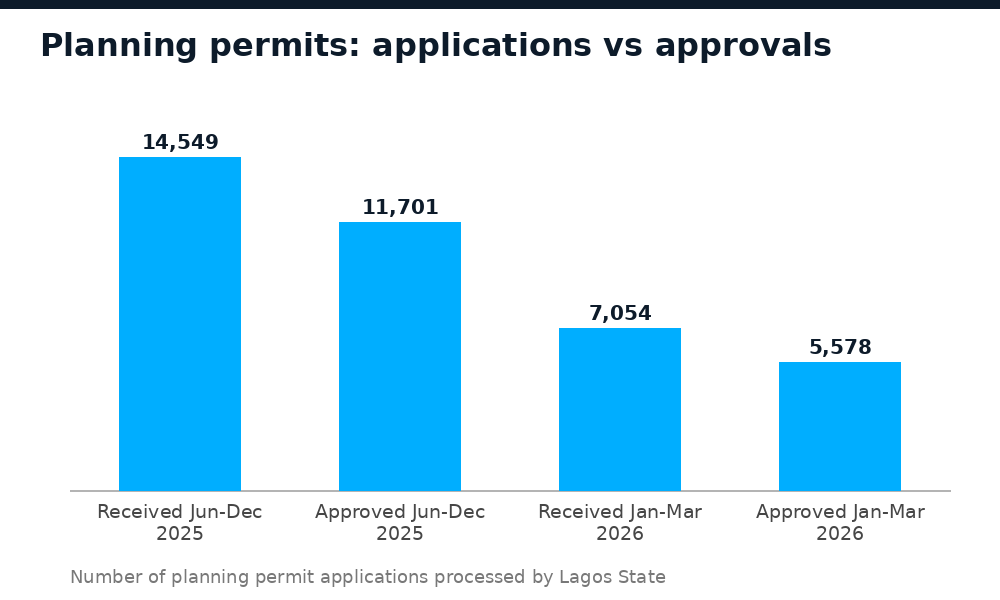
Read those two periods as separate snapshots rather than a trend — the first covers seven months and the second only three, so the totals are not directly comparable. What is worth reading is the gap within each period. In both windows, a meaningful share of applications did not end in an approval. A developer telling you an application has been “submitted” is telling you nothing about the outcome.
How do I check whether an estate has an approved layout plan?
Ask the planning authority directly rather than the person selling to you. The practical sequence:
- Get the scheme’s exact identity first. The estate’s marketing name is often not the name on the planning file. Ask for the registered scheme name, the survey plan number and the local government area before you go anywhere.
- Take that to the Ministry of Physical Planning and Urban Development and ask specifically whether the layout for that scheme is approved, and to see the approval reference. “Approved” and “in process” are different answers — insist on which one applies.
- Check the published list. If the estate appears among the named schemes, stop and get an explanation in writing before any money moves.
- Ask about the plot, not just the estate. Even inside an approved layout, individual plots can fall on land reserved for roads, drainage or public open space. Confirm your specific plot number appears on the approved layout.
- Do this before payment, not after reservation. Once a deposit is in, your leverage collapses and refund terms are whatever the contract says.
What should I demand in writing before I pay?
Verbal reassurance from a sales agent is worth nothing if a demolition notice arrives. Before money changes hands, get on paper: the approved layout reference for the scheme, confirmation that your plot number sits within that approved layout, and a clause covering what happens to your money if the scheme turns out not to be approved. A developer who is genuinely approved will produce these without friction. Hesitation at this stage is itself the answer.
Keep every payment receipt, the allocation letter and the survey documents together. If a scheme is later contested, the buyers who recover something are almost always the ones who can document exactly what they paid for and when.
I have already bought into a flagged estate — what now?
Act early rather than waiting to see what happens. Establish first whether your developer is pursuing regularisation and ask for evidence of it, not assurances. Buyers in the same scheme are in an identical position, and a group that approaches the developer and the planning authority together is taken more seriously than individuals arriving one at a time. Keep your documentation complete, and take proper legal advice on your specific contract before agreeing to any variation the developer proposes.
The regularisation window that has been opened is genuinely an opportunity — schemes that fix their planning position stop being a liability. But that depends on the developer actually using it.
The short version
A clean title tells you the seller owns the land. It does not tell you the estate is approved. Those are two questions, and in the current Lagos enforcement climate the second one is the one catching buyers out. Before you pay for a plot — particularly anywhere in Ibeju-Lekki, Epe or Eti-Osa — confirm the layout approval with the planning authority, confirm your specific plot sits inside it, and get both in writing. It is an afternoon’s work against a risk measured in years of savings.