Nothing kills a Lagos land purchase faster than a title that turns out to be worthless. Two problems dominate the horror stories: Omo-Onile disputes, where rival “family representatives” each claim the right to sell the same plot, and fake Certificates of Occupancy that look convincing on paper but do not exist in any official record. This guide walks through how to verify a land title properly, the red flags to watch for, and the checklist to complete before you pay a single naira.
Verifying a land title: the steps
Title verification in Lagos is not a single document check — it is a sequence of independent confirmations, each closing off a different way the deal could go wrong.
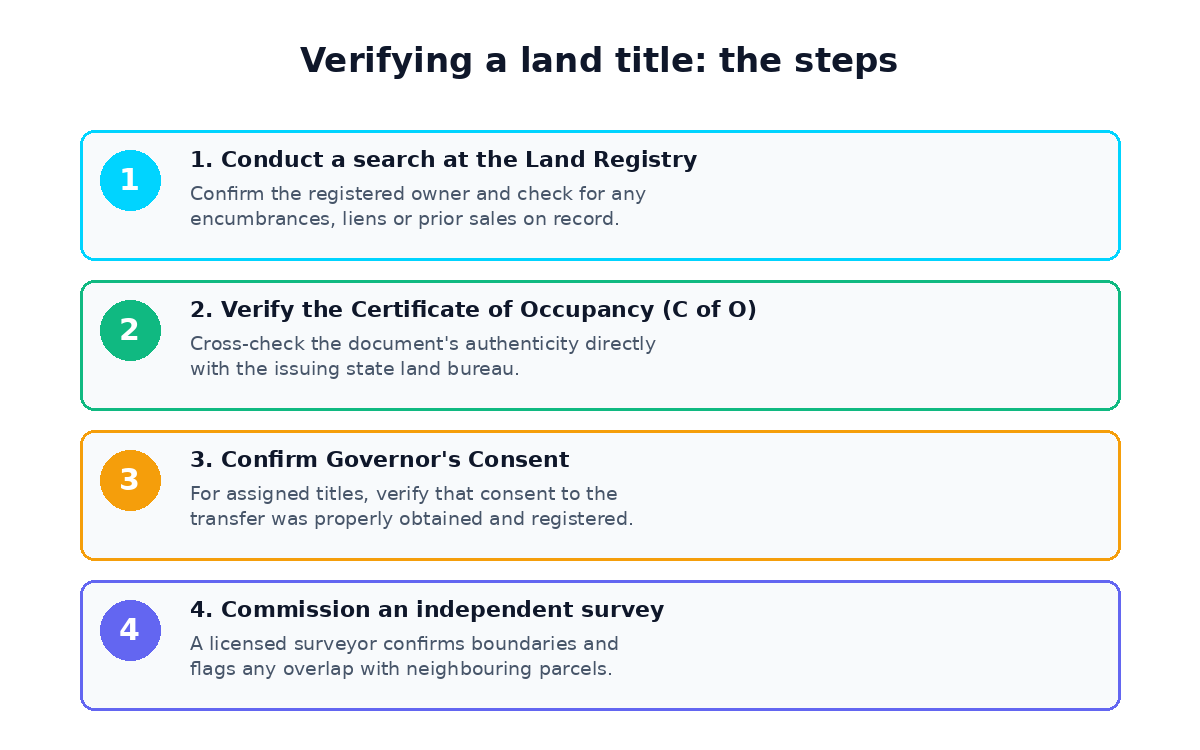
Start with a search at the Land Registry to confirm the registered owner and check for any encumbrances, liens or prior sales already on file. Then verify the Certificate of Occupancy directly with the issuing state land bureau — never take the seller’s copy at face value. For assigned titles, confirm that Governor’s Consent to the transfer was properly obtained and registered. Finally, commission an independent survey from a licensed surveyor to confirm the actual boundaries and flag any overlap with neighbouring parcels.
Understanding the Omo-Onile risk
Omo-Onile (literally “children of the landowner”) refers to family or community members who assert customary ownership over land, sometimes independently of — or in direct conflict with — a registered title. Disputes arise when multiple people, each claiming to represent the same family, sell or “authorise” the sale of the same plot to different buyers, or demand additional payments after a sale has already closed. A credible transaction always traces ownership back to a single, verifiable party whose authority to sell has been confirmed in writing.
Red flags: Omo-Onile and fake C of O schemes
Certain patterns repeat themselves across fraudulent land deals in Lagos. Learn to spot them early.
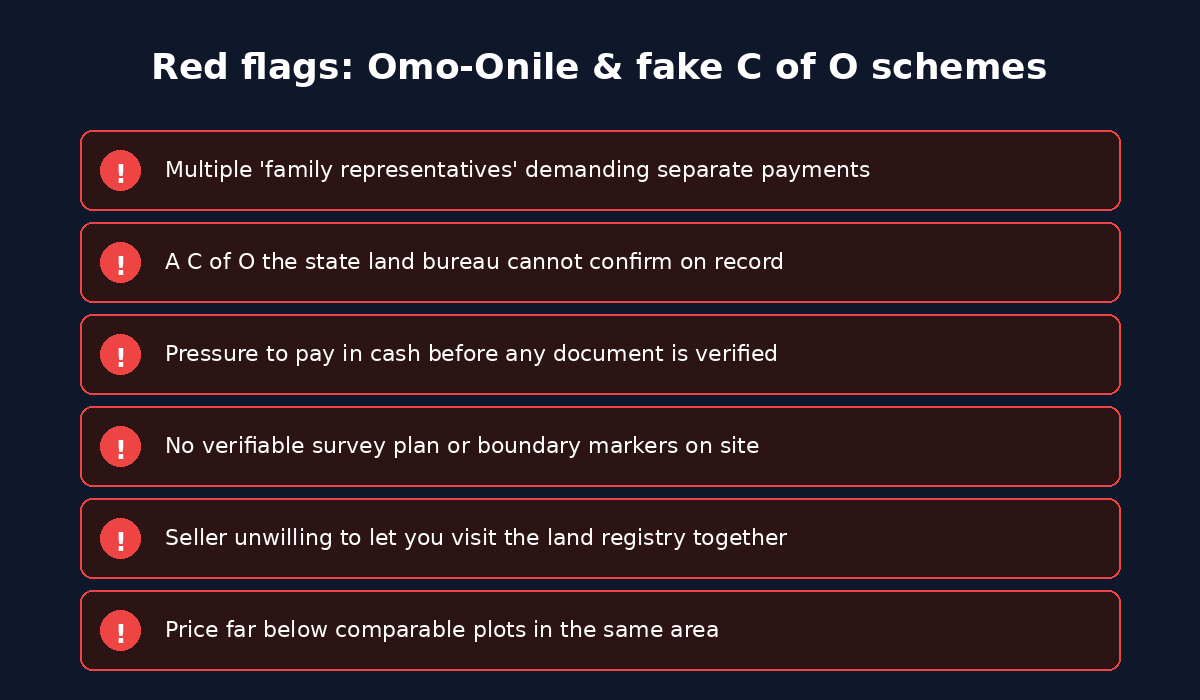
Be wary of multiple “family representatives” each demanding separate payments, a C of O the state land bureau cannot confirm on its own records, pressure to pay in cash before any document has been verified, the absence of a verifiable survey plan or boundary markers on site, a seller unwilling to accompany you to the land registry, and a price far below comparable plots in the same area. Any one of these should slow you down; two or more should stop you entirely.
Secure title vs risky title
Side by side, the difference between a safe purchase and a costly mistake usually comes down to a handful of concrete facts.
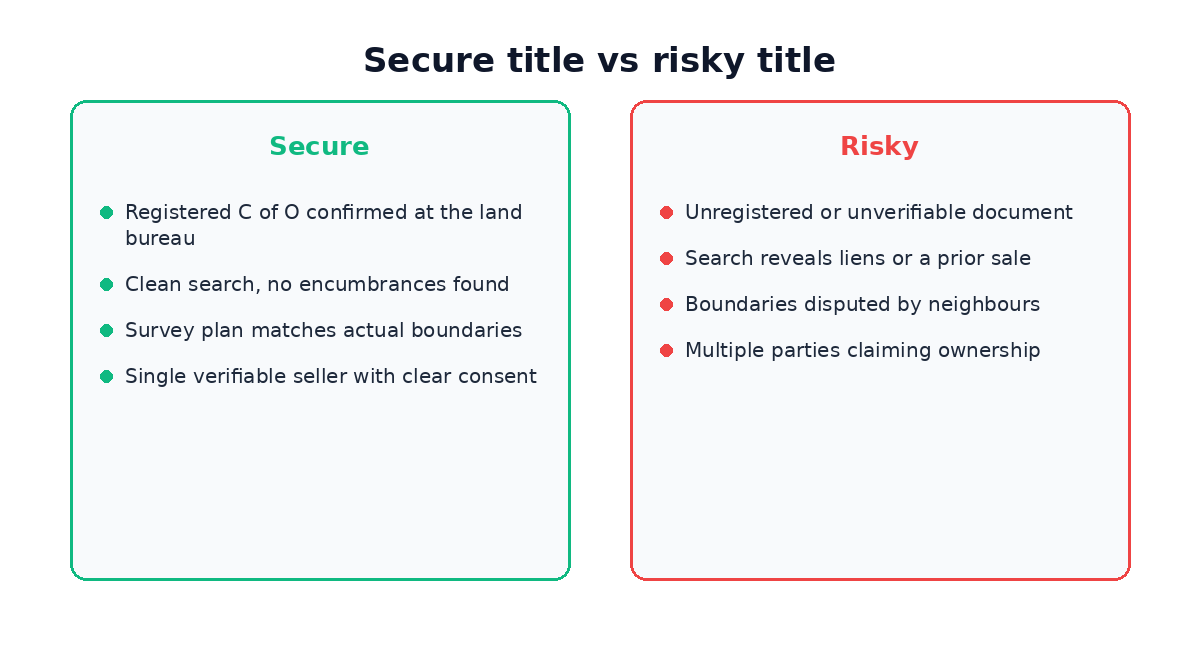
A secure title has a registered C of O confirmed at the land bureau, a clean search with no encumbrances, a survey plan that matches the actual boundaries on the ground, and a single verifiable seller with clear consent to sell. A risky title shows an unregistered or unverifiable document, a search that reveals liens or a prior sale, boundaries disputed by neighbours, or several parties simultaneously claiming ownership.
Checklist before you pay
Before any money changes hands, work through this list in full — not as a formality, but as your actual protection.
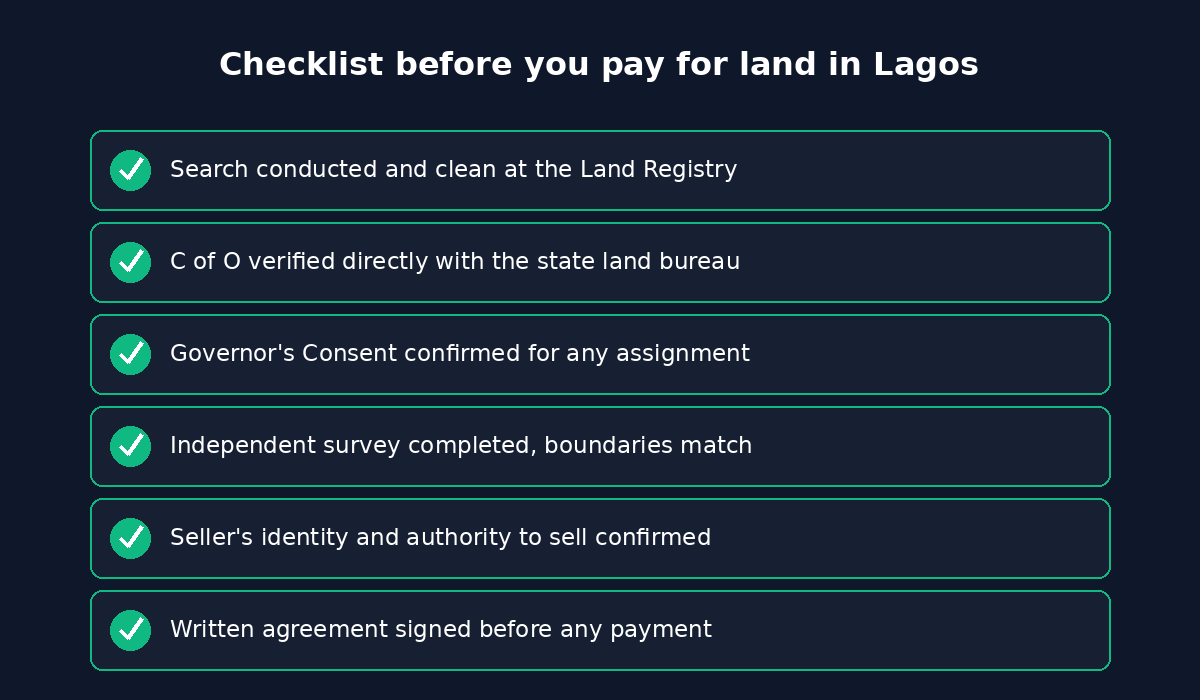
- Search conducted and clean at the Land Registry.
- C of O verified directly with the state land bureau.
- Governor’s Consent confirmed for any assignment.
- Independent survey completed, boundaries match.
- Seller’s identity and authority to sell confirmed.
- Written agreement signed before any payment.
Bring in a lawyer — it is cheaper than the alternative
Every step above can be done faster, and far more safely, with a property lawyer involved from the start. Legal fees are a fraction of the cost of losing a plot to a fraudulent seller or an unresolved Omo-Onile claim — and a lawyer knows exactly which registry entries and consent documents to demand before you commit.
Frequently asked questions
Can I verify a C of O myself, without a lawyer?
You can start the process yourself, but confirming authenticity with the state land bureau and interpreting the search results is best done with a qualified professional.
What if the seller refuses to visit the land registry with me?
Treat this as a serious warning sign. A genuine seller with nothing to hide has no reason to avoid a joint verification.
Does a survey plan replace the need for a registry search?
No — a survey confirms physical boundaries, while a registry search confirms legal ownership and any encumbrances. You need both.
This article is general information, not legal advice; consult a qualified property lawyer before any land transaction in Lagos.