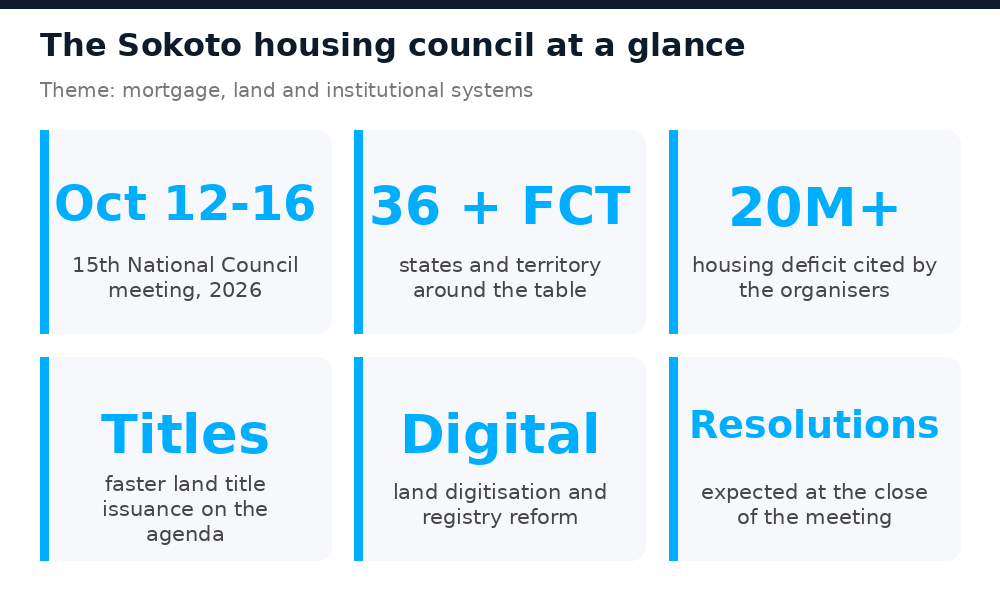
From 12 to 16 October 2026, Sokoto hosts the 15th meeting of the National Council on Land, Housing and Urban Development. The Federal Government, the 36 states and the Federal Capital Territory meet under the theme “Strengthening Mortgage, Land and Institutional Systems for Accelerated and Inclusive Housing Delivery”. On the agenda: land reform, faster issuance of land titles and the digitisation of land records.
For anyone who owns land, is waiting for a Certificate of Occupancy or is about to buy a plot, the question is simple: will anything change, and when? This article explains what the council can and cannot do, why reforms take time to reach your file, and what you can do now to be ready.
Key points in 30 seconds
- The 15th National Council on Land, Housing and Urban Development meets in Sokoto from 12 to 16 October 2026.
- Expensive land title processes and poor federal-state coordination are among the bottlenecks on the agenda.
- Expected outcome: resolutions on land reform, faster title issuance and stronger institutions.
- Land administration is largely a state matter: each state decides how and when to implement.
- Best preparation: a complete, consistent and digitised land file, with charges paid up to date.
What is the National Council on Land, Housing and Urban Development?
The council is the main policy forum where the Federal Ministry of Housing and Urban Development meets the states’ housing and land officials. This year’s meeting brings together state commissioners for housing, permanent secretaries, heads of state housing corporations, surveyors-general and land registry officials, alongside industry stakeholders. It is led by the Minister of Housing and Urban Development, Muttaqha Rabe Darma, and the Minister of State, Yusuf Abdullahi Ata.
Its role is to review progress, share state experiences and agree on coordinated policy actions. Its output takes the form of resolutions, which then have to be implemented by each level of government.
Why are land titles at the centre of the meeting?
Because the land title is where many housing projects stall. Stakeholders have repeatedly identified expensive and slow land title processes as a major reason why Nigeria’s housing deficit, put at over 20 million units by the organisers, remains so high. Without a clean title, land cannot be developed with confidence, sold safely or used as security, and developers pass the cost of delays on to buyers.
For individual owners, the consequences are familiar: years of waiting for a Certificate of Occupancy, consent fees on every transaction, and disputes over land whose ownership is poorly documented. We explained the basics of title verification in our guide to buying land safely in Nigeria.
What could land digitisation change for owners?
Digitisation of land registries is one of the reform themes on the table. In practice, a digital registry can make title searches faster, reduce the risk of the same plot being sold twice, and make processing times more transparent. Some states have already moved in this direction; Abuja’s land information system, for instance, lets owners check their ground rent status online, as we described in our article on Abuja ground rent and AGIS.
Digitisation also has a flip side. Records that were once vague become precise, and inconsistencies in an owner’s documents, such as names, plot numbers or survey coordinates that do not match, become visible. Owners with clean files benefit; those with gaps may need to regularise.
Why will nothing change overnight?
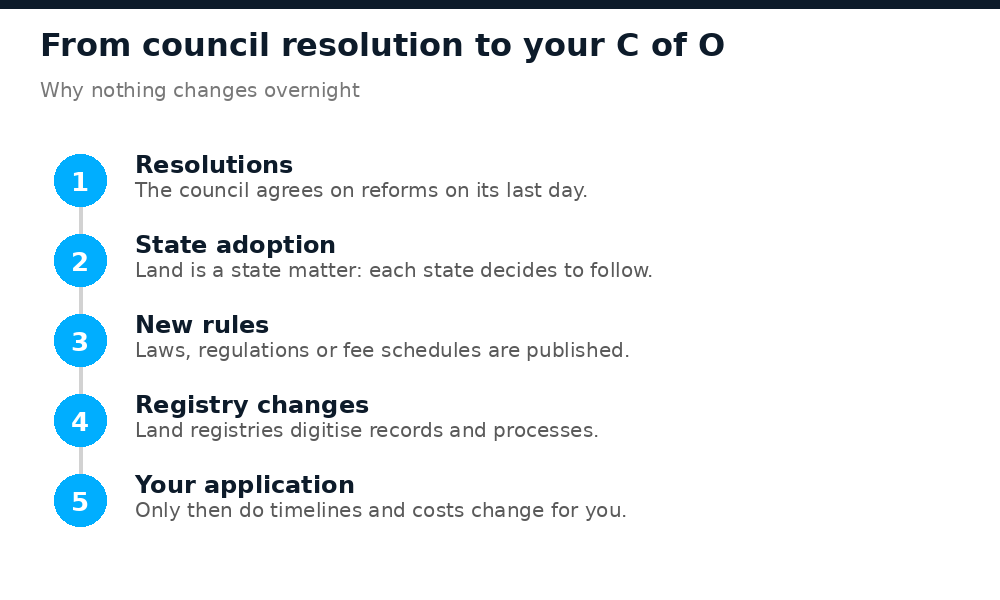
Because land is largely administered by the states under Nigeria’s land tenure framework. The council can agree on direction, but each state government decides whether and how to follow: by passing laws, issuing regulations, changing fee schedules or modernising its registry. That process takes months, sometimes years, and varies widely from one state to another.
The sequence typically runs from council resolutions, to state adoption, to new rules, to changes in registry practice, and only then to visible changes in your own application. Treat any claim that “the new system” already applies to your file with caution, especially if it comes with a request for payment.
What should you do with your land title now?
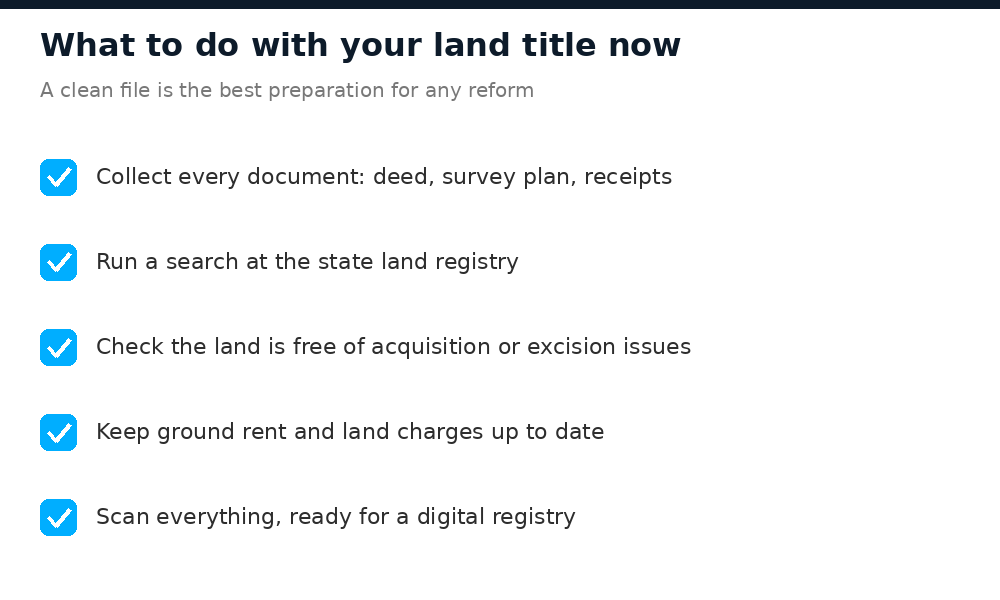
Reforms reward owners who are ready. Whatever the council decides, these steps strengthen your position:
- collect every document: deed of assignment, survey plan, receipts, previous titles;
- run a search at the state land registry to confirm what is recorded in your name;
- check the land’s status: free of government acquisition, and covered by excision or gazette where relevant;
- keep ground rent and land charges up to date, as arrears can jeopardise a title;
- scan everything and keep secure copies, ready for a digital registry.
In Lagos and Ogun, the excision and gazette question deserves particular attention, as we explained in our article on excision and gazette.
Should you wait for the reform before buying land?
No. Reforms will take time to reach registries, and the risks of buying land in Nigeria come mainly from the seller and the land itself, not from the law. A plot with a verified title, a confirmed survey and a clean registry search remains a sound purchase today; a plot without them will not become safe because of a council resolution.
What the reform may change is the speed and cost of getting a title after purchase. That is worth following, but it is not a reason to postpone a well-verified transaction, nor to rush into a poorly verified one. For the most common pitfalls, see our guide to land title verification in Lagos.
Sources
- “Nigeria’s Housing Deficit: FG, 36 States To Fix Mortgage and Land Title Bottlenecks At Sokoto Council Meeting”, Prestige Real Estate News, 4 October 2026.
- “Nigeria Targets Stronger Land, Mortgage Systems for More Inclusive Housing”, Nigeria Housing Market.
Frequently asked questions
When and where is the 2026 National Council on Land, Housing and Urban Development?
It takes place in Sokoto from 12 to 16 October 2026. It is the 15th meeting of the council.
Will the council make it faster to get a Certificate of Occupancy?
Faster title issuance is on the agenda, but the council only adopts resolutions. Actual timelines change only when each state implements new rules and modernises its land registry.
Does the council’s decision apply to all states?
Its resolutions guide policy, but land is largely administered by state governments, which decide how and when to implement them.
What is land digitisation?
It is the move from paper records to digital land registries, which can make searches faster, reduce double sales and make processing times more transparent.
Should I delay buying land until the reforms are in place?
No. A properly verified plot is a sound purchase today. Reforms may make titling faster and cheaper later, but they will not make an unverified plot safe.
How can I prepare my land file for a digital registry?
Gather all documents, run a registry search, check the land’s acquisition and excision status, pay land charges up to date and keep scanned copies of everything.