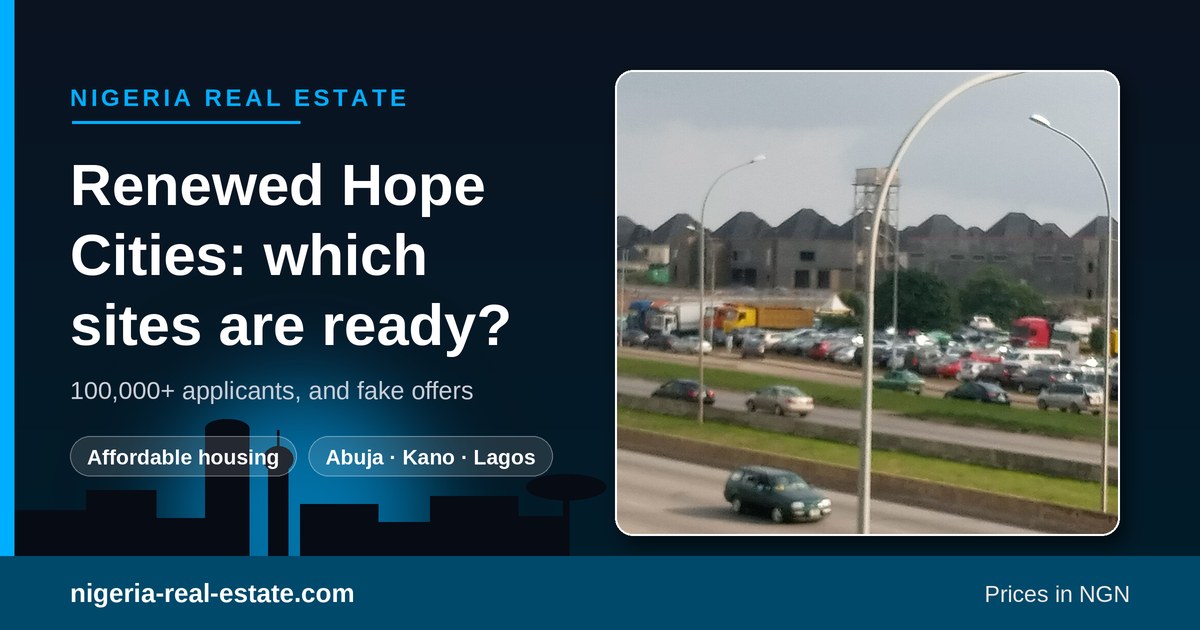
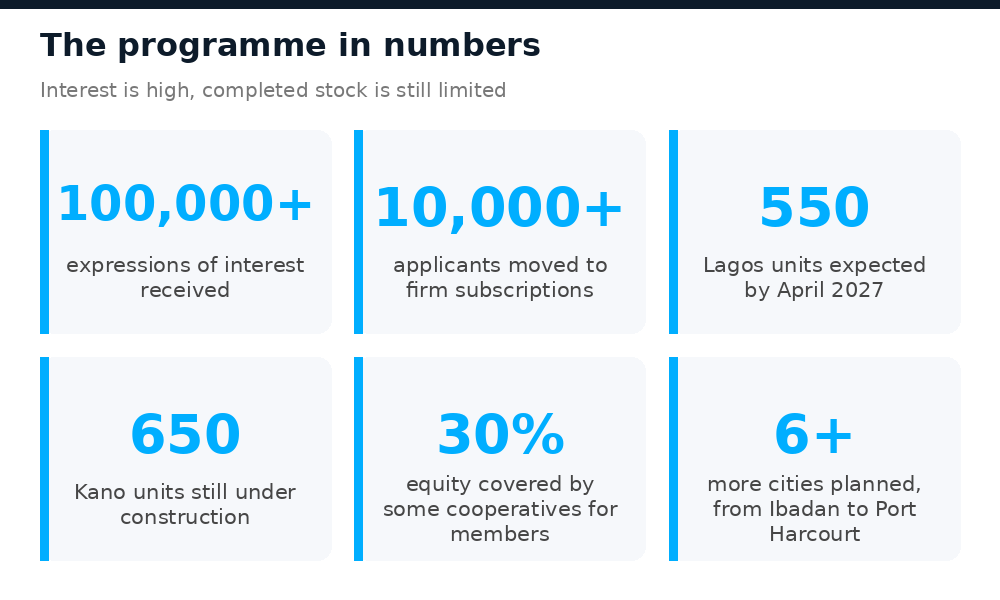
The Federal Government’s Renewed Hope Cities programme has passed a symbolic milestone. According to figures reported in early October 2026, it has received more than 100,000 expressions of interest, and over 10,000 applicants have moved on to firm subscriptions. Estates are taking shape in Abuja, Kano and Lagos, with more cities planned.
Behind the headline number, the picture is more nuanced. Some sites are close to completion, others are still under construction or only planned. And every popular housing scheme in Nigeria attracts the same parasites: fake agents selling “guaranteed allocations”. Here is where the programme actually stands, site by site, and how to tell a genuine offer from a scam.
Key points in 30 seconds
- Renewed Hope Cities: 100,000+ expressions of interest and 10,000+ firm subscriptions as of early October 2026.
- Karsana in Abuja (2,400 units) is approaching completion; Kano’s Janguza site has 350 units completed and 650 under construction.
- In Lagos, 2,004 units are planned on Monastery Road, with the first 550 expected by April 2027.
- Further projects are planned in Asaba, Ibadan, Katsina, Enugu, Sagamu-Papalanto and Port Harcourt.
- No genuine allocation is sold through a personal account or a “guarantee fee”.
What is the Renewed Hope Cities programme?
Renewed Hope Cities is the flagship of the Federal Government’s housing agenda: large estates delivered by the Federal Ministry of Housing and Urban Development with partners, aimed at low- and middle-income earners. Homes are offered through several windows, including outright purchase and rent-to-own, and some employers and cooperatives help their staff or members with the required equity contribution.
We covered the subscription process and eligibility rules when the scheme was first rolled out, in our guide to the Renewed Hope Housing Programme. This article focuses on what has changed since: the scale of demand, and the real state of each site.
Which Renewed Hope sites are ready?
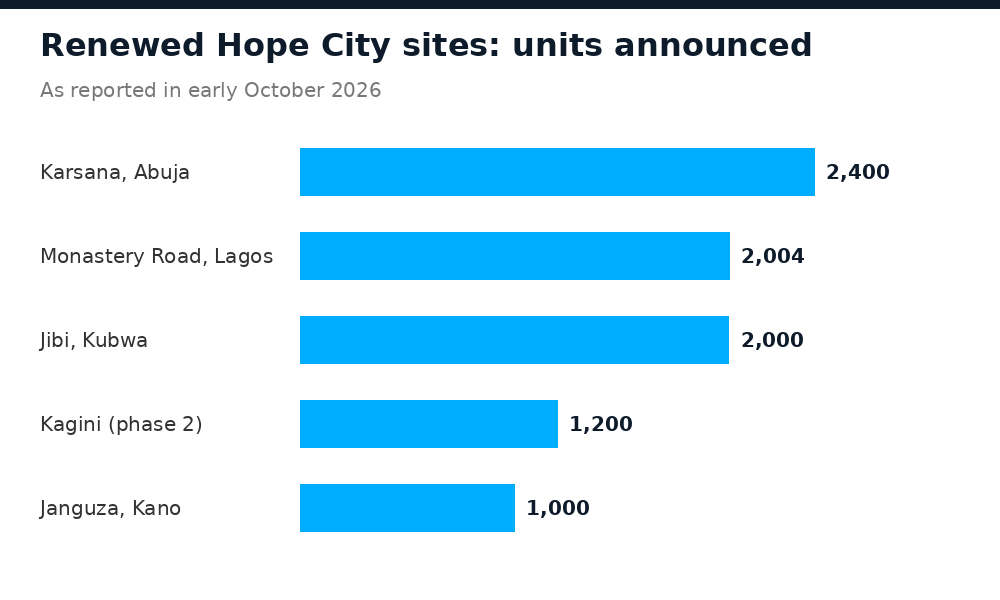
Based on the figures reported in October 2026, the sites are at very different stages:
- Karsana, Abuja: 2,400 units, approaching completion. This is the most advanced large site.
- Janguza, Kano: 1,000 units, of which 350 are completed and 650 under construction, with delivery expected in March 2027.
- Monastery Road, Lagos: 2,004 units along the Lekki-Epe corridor opened up by the Lagos-Calabar Coastal Highway, with the first 550 expected by April 2027.
- Jibi, Kubwa: 2,000 units planned.
- Kagini: 1,200 units in a planned second phase.
In other words, a large share of the units behind the headline figures will not be available before 2027. If you are subscribing today, ask for the exact site, phase and expected delivery date of the unit you are being offered.
Why does demand outstrip supply so heavily?
Because the gap is structural. Nigeria’s housing deficit is estimated in the tens of millions of units, and formal, titled, serviced homes at accessible prices are rare. A government-backed estate with clear titles and infrastructure is exactly what many households cannot find on the open market, which explains the rush. We looked at the scale of the shortage in our article on Nigeria’s housing deficit in 2026.
With 100,000 expressions of interest for a few thousand units ready in the short term, most applicants will wait. That waiting time is precisely what fraudsters exploit.
How do fake allocation offers work?
The pattern rarely changes. Someone presents themselves as an insider, a ministry official, a developer’s agent or a “consultant”, and offers to fast-track your allocation for a fee. You are shown a brochure, sometimes a forged allocation letter, and asked to pay quickly into a personal account before the “window closes”.
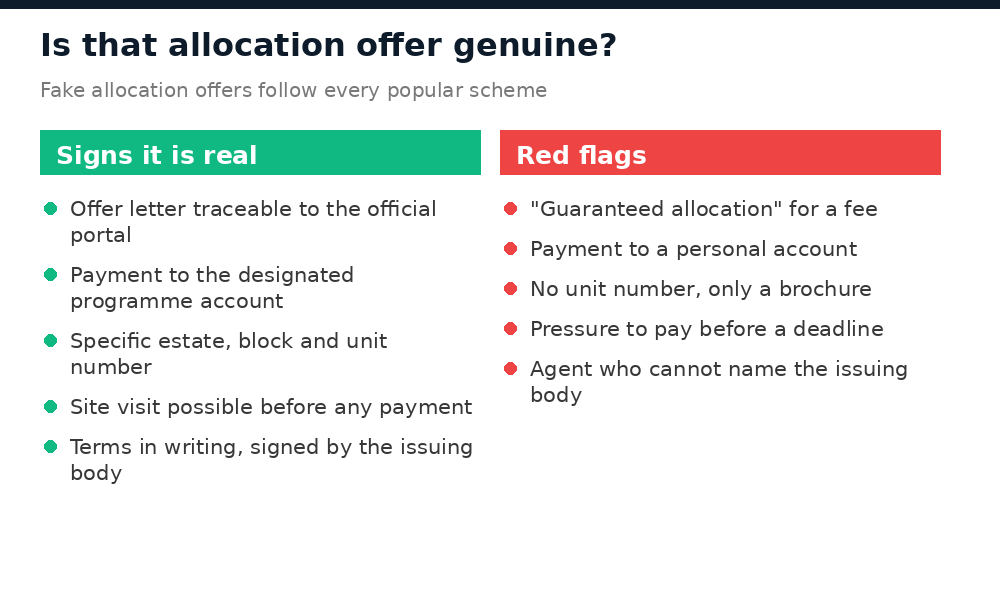
The red flags are consistent:
- a “guaranteed allocation” in exchange for a fee;
- payment to a personal account rather than the designated programme account;
- no specific estate, block and unit number, only marketing material;
- pressure to pay before an artificial deadline;
- an agent who cannot name the issuing body or give verifiable contact details.
Similar schemes have targeted applicants to the Lagos State schemes, which we covered in our guide to Lagos home ownership and rental schemes.
How do you verify an allocation offer?
Start from the official source and work outwards, never the other way round. Check that the offer letter can be traced to the programme’s official portal or the issuing body. Confirm the payment account directly with the ministry or the official programme channel, not with the person who sent you the details. Insist on a specific estate, block and unit number, and visit the site before any payment.
Keep every document: application receipts, correspondence, payment evidence. If you are buying off-plan from a private developer instead, the same discipline applies, and the proposed licensing and escrow rules we analysed in our article on developer licensing and escrow are worth knowing.
Which payment route makes sense?
The programme offers several windows, and the right one depends on your situation. Outright purchase suits buyers with savings or family support. Rent-to-own spreads the cost over time while you live in the home, and some cooperatives cover part of the equity contribution for their members. Whatever the route, read the full terms in writing: total price, schedule, what happens if you miss a payment, and when the title is transferred to you.
We compared these routes in more detail in our article on off-plan and rent-to-own property in Nigeria.
What should you expect next?
Watch three things. First, the completion and handover of Karsana, which will be the first real test of delivery at scale. Second, the 2027 timelines in Kano and Lagos. Third, the launch of the sites announced in Asaba, Ibadan, Katsina, Enugu, Sagamu-Papalanto and Port Harcourt, which would spread the programme beyond its current hubs.
Sources
- “Renewed Hope Housing Programme Gains Traction as Projects Spread Across Nigeria”, Nigeria Housing Market, October 2026.
Frequently asked questions
How many people have applied for Renewed Hope Cities homes?
More than 100,000 expressions of interest had been received as of early October 2026, with over 10,000 applicants moving on to firm subscriptions.
Which Renewed Hope estate is closest to completion?
Karsana in Abuja, with 2,400 units, was reported as approaching completion in October 2026.
When will the Lagos Renewed Hope homes be ready?
Of the 2,004 units planned on Monastery Road along the Lekki-Epe corridor, the first 550 are expected by April 2027.
Can an agent guarantee me an allocation?
No. A guaranteed allocation sold for a fee is a classic scam. Genuine allocations follow the official process and payments go to the designated programme account.
How can I check that an allocation letter is genuine?
Trace it back to the official portal or issuing body, confirm the payment account through official channels, insist on a specific unit number and visit the site before paying.
Which other cities will get Renewed Hope estates?
Projects are planned in Asaba, Ibadan, Katsina, Enugu, Sagamu-Papalanto and Port Harcourt, in addition to the existing sites in Abuja, Kano and Lagos.