Every new academic session pushes thousands of students into the Lagos rental market at once — and the fake listings come out in force. Here is how to target the right area for your budget, spot a scam before you part with money, and lock down a tenancy that holds for the year.
Where to look, by commute and budget
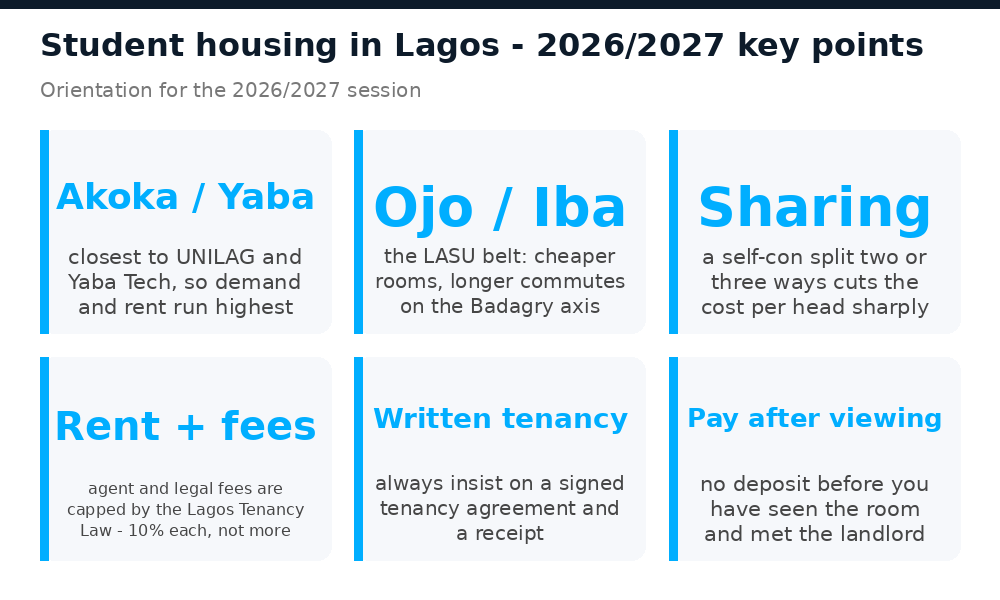
The rule is simple: the closer you are to campus, the higher the rent. Akoka and Yaba sit next to UNILAG and Yaba College of Technology, so demand and prices run highest there. The Ojo–Iba belt along the Badagry axis serves LASU with cheaper rooms, at the cost of longer commutes. Areas like Bariga, Shomolu and Ketu offer a middle ground — a bit further out, but better value with reasonable transport links.
Sharing is the real saving
Splitting a self-contained apartment or a two-bedroom flat two or three ways cuts the cost per head far more than downsizing to a single room in a cheaper area. If you share, put it in writing: either one tenancy agreement naming every occupant, or separate agreements per room, plus a written split of rent, service charge and caution, and a shared inventory.
Spotting a fake listing
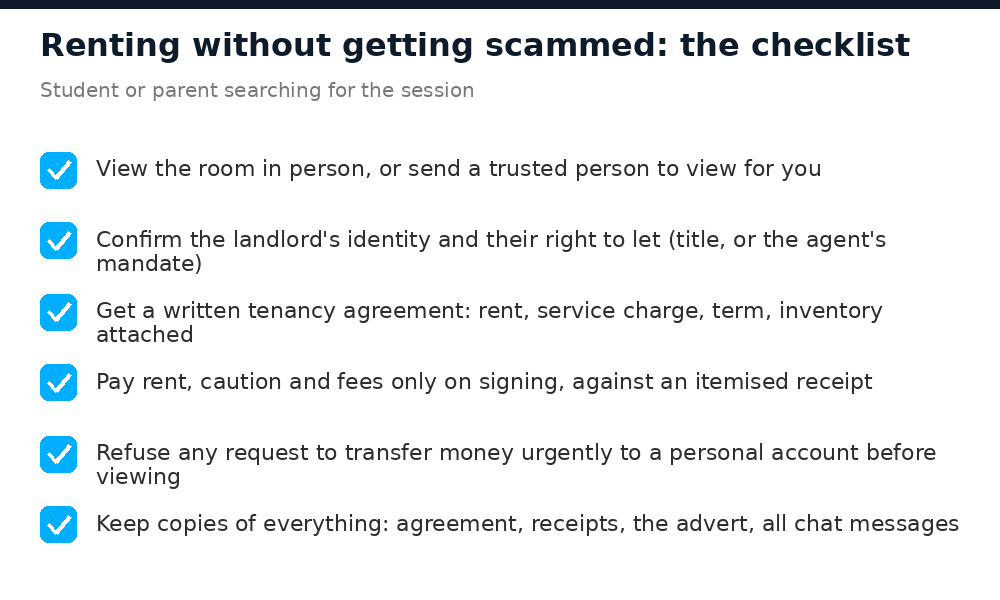
Rental scams targeting students follow a script: a room that looks “too good” at a suspiciously low rent, a landlord or “agent” who is travelling and cannot show you round, and a demand to send the caution now to hold it, usually to a personal account or by transfer. None of that is acceptable.
Fees: what the Lagos Tenancy Law caps
The Lagos Tenancy Law caps agency fees and legal fees at 10% of the annual rent each — not the 20% or 30% some agents still quote. It also limits how far in advance rent can be demanded for certain tenancies. Ask for a breakdown in writing: rent, caution (refundable), agency fee, legal/agreement fee. Anything labelled “inspection fee” paid before you have seen the place is a warning sign.
The tenancy agreement
Insist on a written, signed tenancy agreement even for a single room. It should state the rent and service charge, the term and renewal terms, notice periods, who repairs what, and it should have an inventory and condition report attached. Pay rent, caution and fees only on signing, against an itemised receipt, and keep a signed copy.
A sensible timeline
- Before the session: shortlist areas, set a “rent plus transport” budget, get your documents ready (ID, admission or student ID, a guarantor if asked).
- While searching: view in person, compare at least three rooms, pay nothing before you have seen a place.
- On signing: read the agreement line by line, check the inventory, pay against a receipt, collect your copy.
- After: keep every document and message in one folder.
Frequently asked questions
Which area is cheapest for a student in Lagos?
Generally the Ojo–Iba belt around LASU and outer mainland areas like Ikorodu. Add the daily transport cost and time to campus before deciding — a cheap room far out is not always cheaper overall.
Can I rent in Lagos without a guarantor?
It is harder. Many landlords want a guarantor with verifiable income. Sharing with other students, or a managed co-living arrangement, can ease that requirement.
How much can an agent legally charge?
Under the Lagos Tenancy Law, agency and legal fees are capped at 10% of the annual rent each. Ask for the breakdown in writing and keep the receipt.
Is a written tenancy agreement really necessary for one room?
Yes. It fixes the rent and term, sets out notice and repairs, and is your evidence if there is a dispute over the caution or a rent increase.
I already paid for a room that turned out to be fake — what now?
Gather every piece of evidence (advert, chats, transfer receipt) and report it to the police, and flag the advert to the platform that carried it.