Ask ten Nigerian property investors where to put their money, and you will get two answers: Lagos or Abuja. Both cities offer genuinely different markets — different tenant profiles, different price dynamics, different risks. Rather than declaring a winner, this guide breaks down how the two compare in 2026, so you can match the city to your own investment goal.
Abuja vs Lagos: at a glance
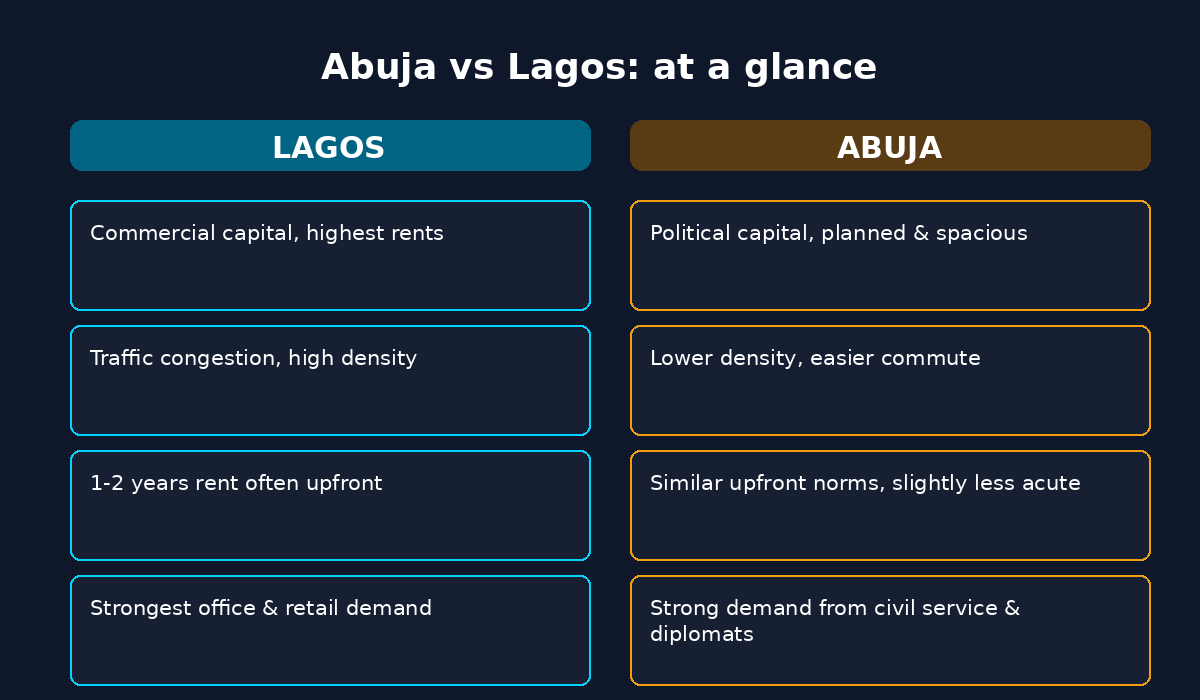
Lagos is Nigeria’s commercial capital: dense, congested, and home to the country’s deepest property market, with the highest rents and the strongest office and retail demand. Abuja, the political capital, offers a more planned layout, lower density and an easier daily commute, with strong demand anchored in the civil service and the diplomatic community.
Where the demand concentrates
Each city has its own map of hotspots, and knowing them matters more than knowing the city’s average rent.
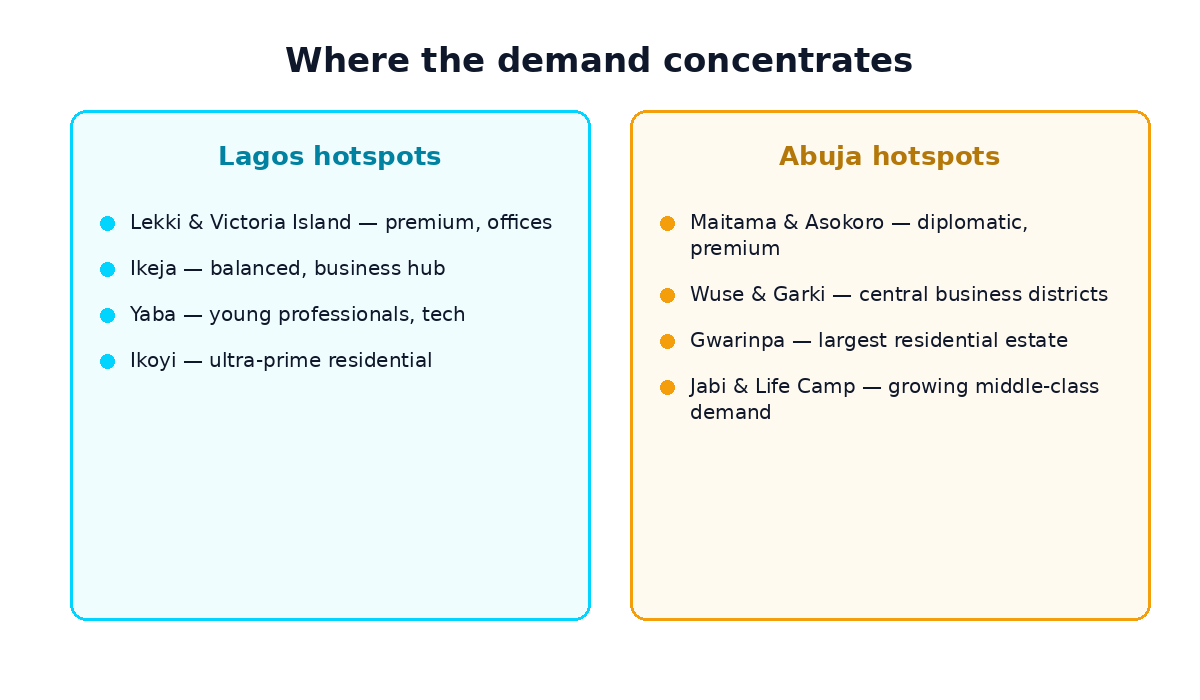
In Lagos, Lekki and Victoria Island carry the premium price tags and office demand, Ikeja balances price and convenience, Yaba draws young professionals and tech workers, and Ikoyi remains the ultra-prime residential address. In Abuja, Maitama and Asokoro are the diplomatic, premium districts, Wuse and Garki form the central business core, Gwarinpa is the country’s largest planned residential estate, and Jabi and Life Camp are absorbing a growing wave of middle-class demand.
Pros and cons for investors
Neither city is simply “better” — each comes with a distinct risk-and-reward profile.
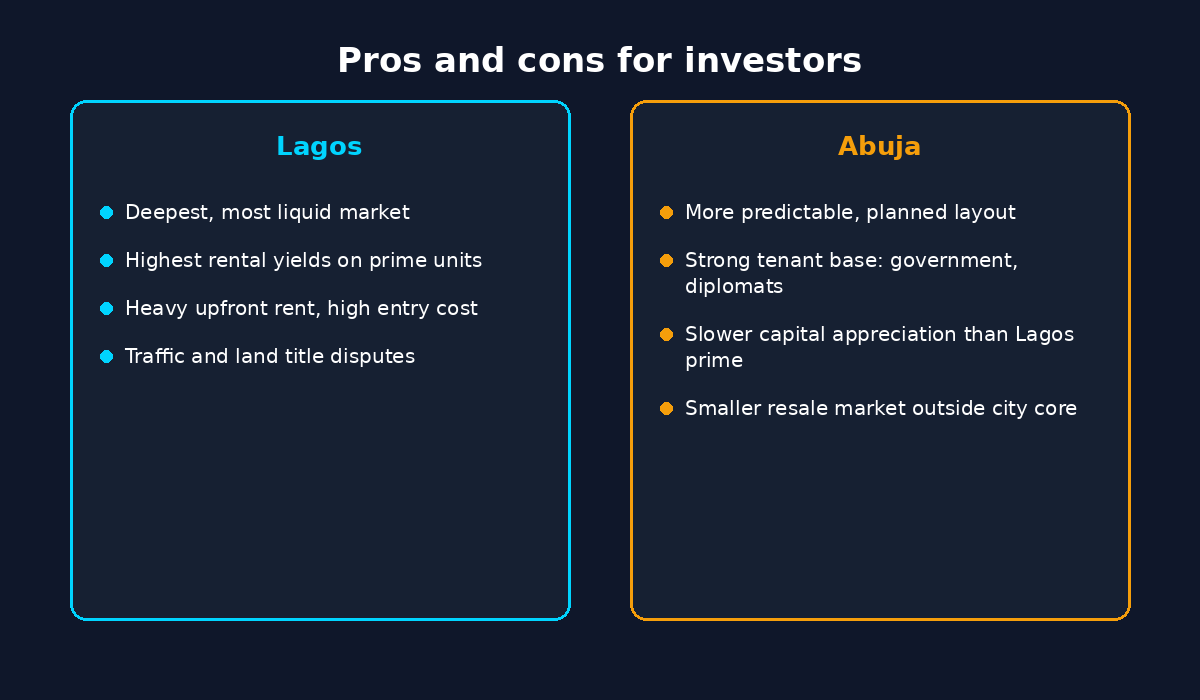
Lagos is the deepest and most liquid market in the country, with the highest rental yields on prime units — but it also demands heavy upfront rent, a high entry cost, and careful attention to land title disputes and traffic-driven access issues. Abuja offers a more predictable, planned layout and a strong, stable tenant base of government workers and diplomats, but capital appreciation tends to be slower than in prime Lagos, and the resale market thins out quickly outside the city core.
Which city fits your investment goal?
The right choice depends less on which city is “hotter” and more on what you are actually trying to achieve.
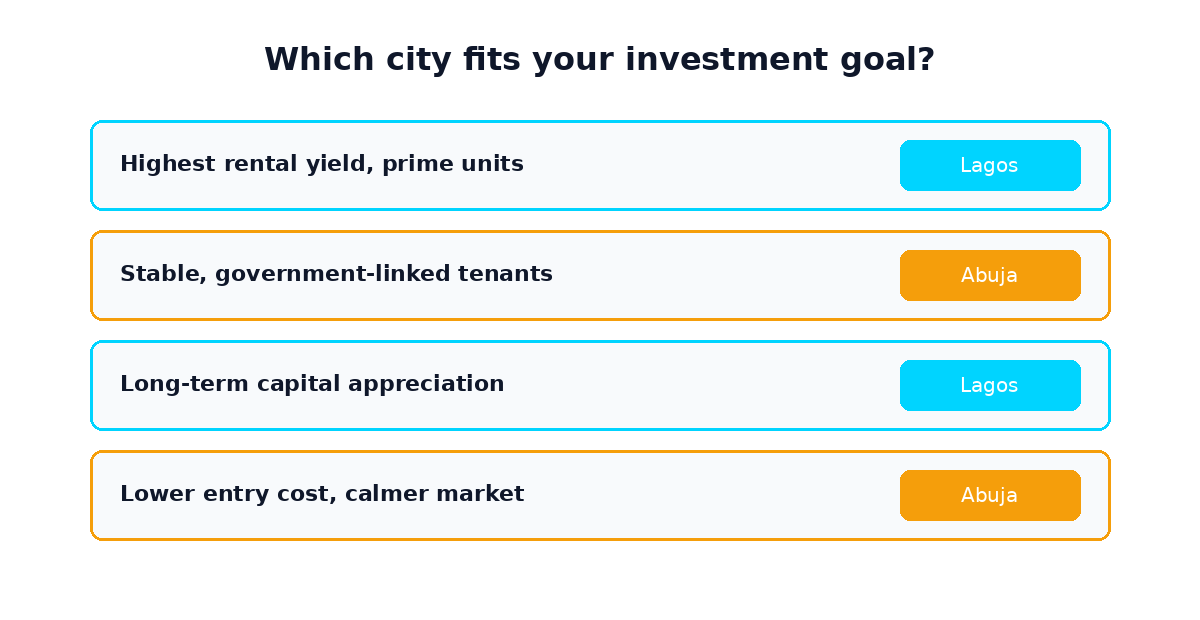
If you want the highest rental yield on a well-located prime unit, Lagos still leads. If you prioritise a stable, government-linked tenant base and lower day-to-day volatility, Abuja is the calmer bet. For long-term capital appreciation, Lagos’s deeper market and scarcity of prime land give it the edge. And if you are working with a lower entry budget and want a calmer, more predictable market to learn on, Abuja is usually the friendlier starting point.
Due diligence applies either way
Whichever city you choose, the fundamentals do not change: verify the land title (Certificate of Occupancy or equivalent) before paying anything, use a credible, verifiable agent, and put every agreement in writing. A great location on paper is worthless if the title behind it cannot survive a legal challenge.
Frequently asked questions
Which city has higher rental yields in 2026?
Prime Lagos locations generally post the highest yields, though Abuja’s stable government and diplomatic tenant base can offer comparable reliability with less volatility.
Is Abuja a safer market for first-time investors?
Its planned layout and more predictable pricing make it easier to underwrite for newcomers, though the resale market is thinner outside the core districts.
Should I diversify across both cities?
Many experienced investors do exactly that — Lagos for yield and liquidity, Abuja for stability — but only once each individual purchase has been properly vetted on its own merits.
This article is general information, not investment advice; consult a qualified real estate professional before committing capital.