Ask a Lagos tenant what their apartment costs and they will quote the rent. Ask what they actually pay and the number is often considerably higher, because of a second charge that is demanded in the same breath, negotiated far less, and accounted for almost never.
Service charge is a legitimate and necessary thing. An estate with functioning security, water and power costs money to run. The problem is not that it exists — it is that it is frequently collected without a budget, spent without a statement, and increased without an explanation.
What service charge is meant to cover
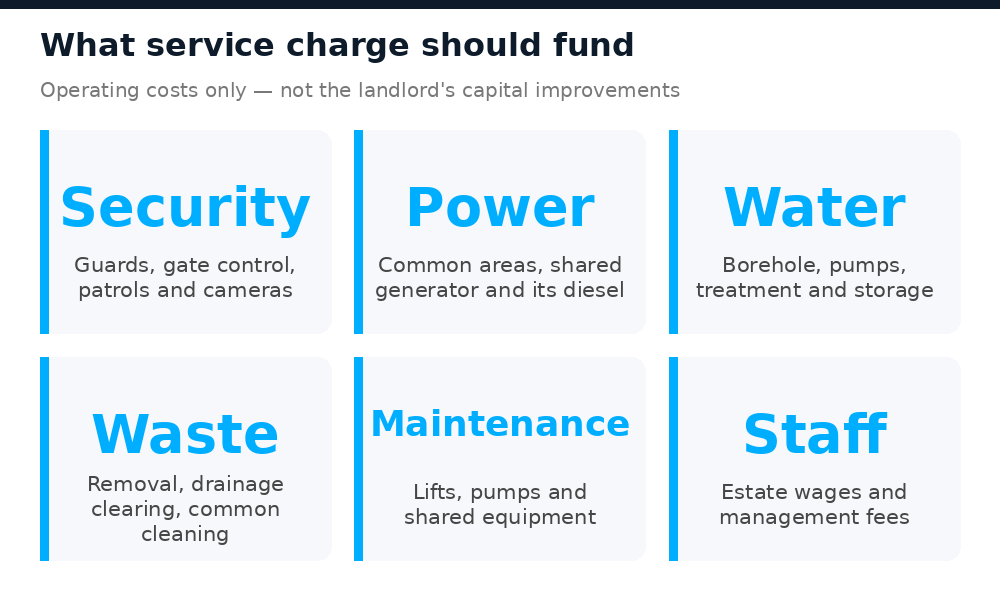
Service charge funds the recurring operating cost of shared areas and shared services. In a typical Lagos estate or apartment block, that means:
- Security — guards, gate control, sometimes patrols and cameras.
- Power for common areas and, in many estates, a shared generator and its diesel.
- Water — borehole, pumps, treatment and storage.
- Waste removal and drainage clearing.
- Cleaning and landscaping of common areas.
- Lift and equipment maintenance in multi-storey buildings.
- Staff wages and estate management fees.
Two things fall outside that list, and this is where most disputes begin. Capital improvements — replacing a generator, resurfacing roads, building a new gatehouse — are investments in the landlord’s asset, not operating costs. And anything specific to your own unit is not a shared cost at all.
Why the charge varies so much between estates
Tenants often compare service charges across estates and conclude they are being overcharged. Sometimes they are. Often they are comparing two different products.
The dominant variable is how much of the estate’s infrastructure is private. An estate that runs its own power for long hours, treats its own water and staffs a manned gate around the clock has a genuinely high running cost. One that relies mainly on public supply and a single gateman does not.
The second variable is how the charge is apportioned. Per unit, per square metre and per bedroom produce very different bills for the same building. A studio paying the same as a four-bedroom unit is not necessarily fraud — but it is a basis you should know about before you sign, not after.
The three questions to ask before you sign
These belong in the negotiation, alongside the rent — not in an argument eleven months later.
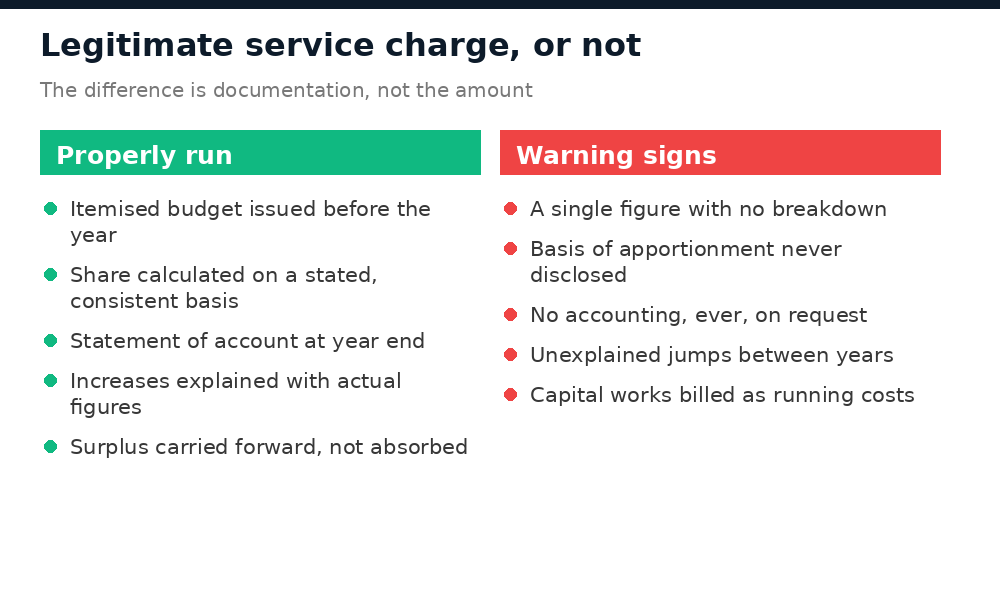
- What exactly does the charge cover, itemised? A single figure with no breakdown is not a service charge, it is a fee.
- How is my share calculated? Per unit, per bedroom, per square metre — and how many units share the total.
- What accounting will I receive, and when? A budget before the year, a statement after it.
Get the answers into the tenancy agreement. A landlord or manager who is running things properly will have no difficulty with any of this. One who resists all three has told you something important.
Advance payment and the accountability that should come with it
Paying service charge a year ahead, alongside annual rent, is common in Lagos. Whatever you think of the practice, the principle that follows from it is simple: if the money is collected in advance, it is being held on your behalf.
That implies two documents — a budget setting out what the year is expected to cost, and a reconciliation at the end showing what was actually spent, with any surplus carried forward rather than absorbed. Neither is exotic. Both are routinely absent.
The rent side of these advance-payment arrangements, including the direction of recent Lagos policy, is covered in Lagos Rent Advance Payment Cap 2026.
Increases: what is fair and what is not
Diesel prices move. Security wages move. An estate whose service charge never changed for five years is probably deferring maintenance, which costs everyone more later. Increases are not, in themselves, a grievance.
What makes an increase challengeable is the absence of the three things that should accompany it: an explanation of which cost lines rose, evidence in the form of the previous year’s actual spend, and consistency — the same basis applied to every unit.
How to challenge a charge you think is wrong
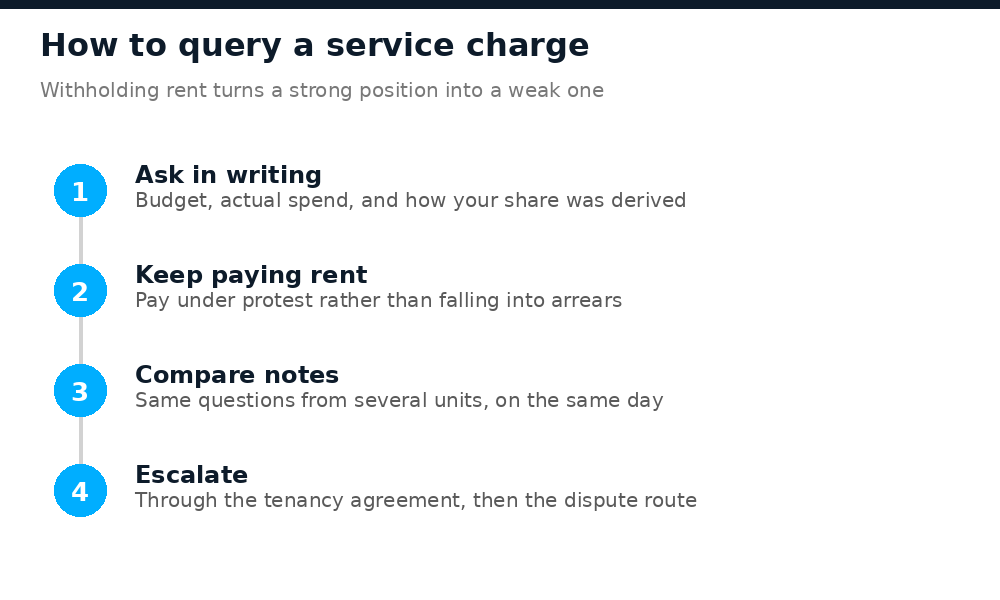
Two rules make the difference between a query that works and one that goes nowhere.
Keep paying your rent. Withholding rent to protest a service charge converts a strong position into a weak one: you move from being a tenant with a legitimate question to a tenant in arrears, and the conversation changes entirely. If a portion of the charge is genuinely disputed, say so in writing and pay under protest rather than simply stopping.
Organise. The same three questions arriving from ten units, in writing, on the same day, are far harder to deflect than one letter — and the answers benefit everyone equally. In buildings with a residents’ association, this is precisely what it exists for.
If the matter cannot be resolved, the escalation path runs through the tenancy agreement and, where relevant, the framework described in Tenancy Disputes in Nigeria. Where an agent sits between you and the landlord, the registration and fee rules in the Lagos Tenancy Bill are worth knowing.
If you are the landlord or the manager
Transparency here is not a concession — it is the cheapest tenant-retention tool available. An itemised budget and a year-end statement cost a few hours of work and remove almost the entire category of service charge disputes.
They also protect you: a manager who can show what was spent is in a far stronger position when a tenant refuses to pay than one relying on assertion. And in a market where tenants increasingly compare total occupancy cost rather than headline rent, a well-run and well-documented estate holds its occupancy better. The wider economics are set out in Apartment Living in Nigeria.
The bottom line
Service charge is the second rent, and it deserves the same scrutiny as the first. Itemise it, understand how your share is calculated, and require a statement of account. Ask before you sign, when you still have leverage — not in month eleven, when you have none.
Frequently Asked Questions
What is service charge supposed to cover?
Service charge funds the running of shared areas and shared services: security, estate power and its diesel, water supply and treatment, waste removal, cleaning of common areas, landscaping, lift maintenance and the wages of estate staff. It is meant to cover recurring operating costs — not to fund the landlord’s capital improvements or to top up rent.
Should service charge be paid a year in advance?
Advance payment is common practice in Lagos, particularly alongside annual rent, but it is a matter of contract rather than a rule of law. If you pay a year ahead, insist on the corresponding accountability: a written budget for that year and a reconciliation at the end showing what was actually spent, with any surplus carried forward.
Am I entitled to see how the money was spent?
You should treat this as non-negotiable and put it in the tenancy agreement before you sign. A service charge is money collected to be spent on your behalf, so a budget before the year and a statement of account after it are the minimum. A manager who refuses any accounting is the clearest single warning sign in the whole arrangement.
Can service charge be increased during my tenancy?
Costs genuinely move — diesel and security wages especially — so increases are not automatically improper. What matters is whether the increase is explained, evidenced and applied to everyone on the same basis. An unexplained jump with no supporting figures is what you challenge, not the existence of an increase.
What can I do if I think the charge is wrong?
Put your query in writing and ask specific questions: what the budget was, what was actually spent, and how your share was calculated. Keep copies and keep paying your rent while the query runs. Organise with other tenants — the same questions from ten units are far harder to ignore than one letter, and the answers affect everyone equally.