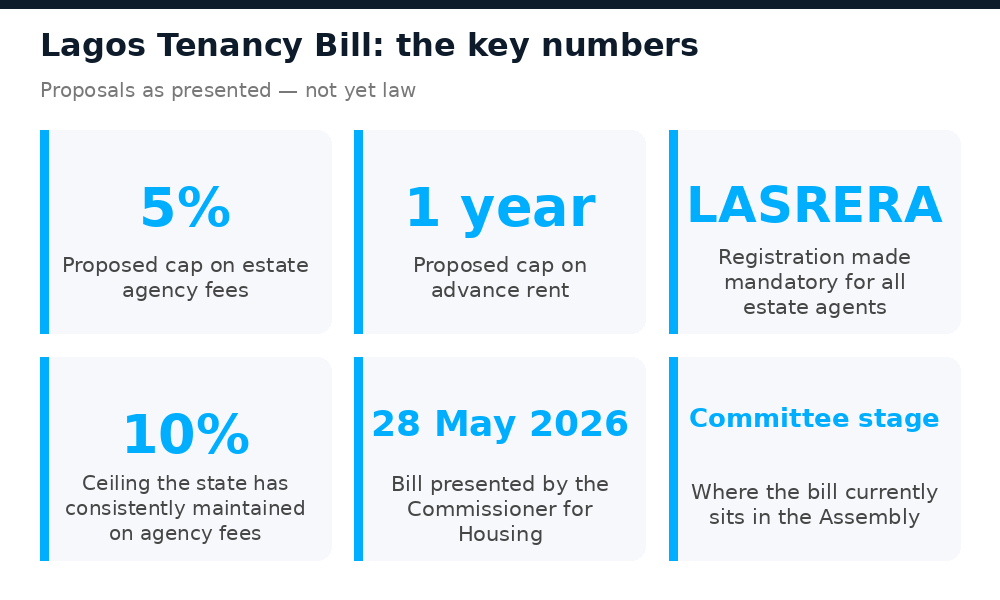
Lagos State has introduced a tenancy bill aimed at regulating rent increases, controlling estate agency fees and tackling fraudulent practices in a rental market where affordability pressure keeps building. Presented on 28 May 2026 by the Commissioner for Housing, it is currently at committee stage in the House of Assembly.
Two provisions matter most to anyone renting this year. First, all estate agents operating in Lagos would be required to register with the state real estate regulatory authority. Second, the proposed law would cap advance rent at one year and agency fees at 5% — against a ceiling of 10% the state has consistently maintained should not be exceeded.
Important caveat before anything else: this is a bill, not yet law. But its logic gives you a practical checklist you can apply today.
Why agent registration is the provision that matters
Rent caps get the headlines, but compulsory registration is the structural change. The reason is simple: an unregistered agent is an agent you cannot trace. Every classic rental scam depends on that untraceability — the “agent” who collects inspection fees from twenty people for the same flat, the one who takes a deposit on a property he does not manage, the one whose phone goes dead the day after payment.
A registration requirement creates a record: a name, a business, an address, an authority that can be petitioned. It does not make fraud impossible, but it changes the odds considerably — provided tenants actually ask for the registration details.
How to check an agent, today
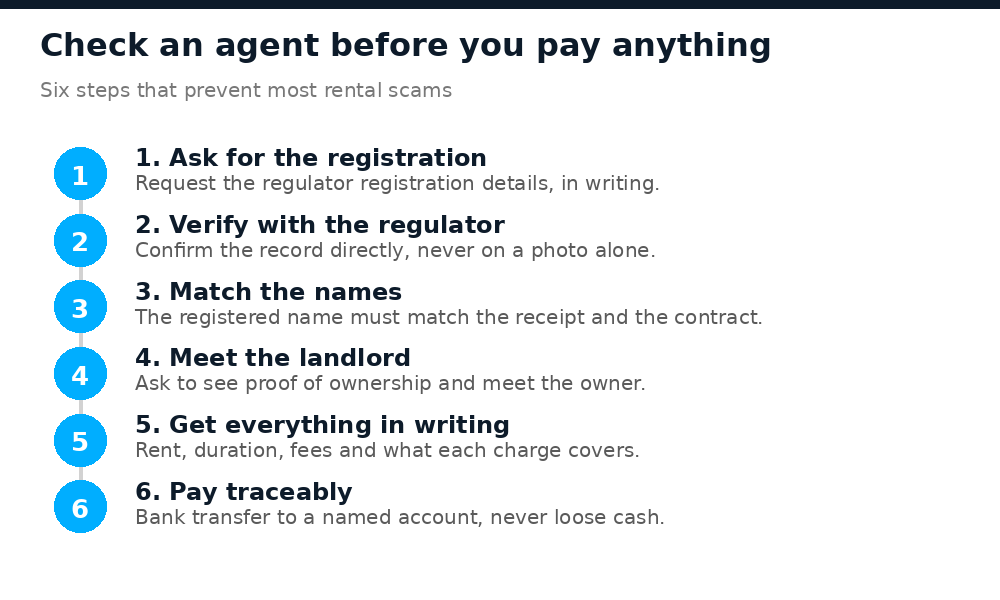
Three of these steps deserve emphasis.
Verify with the regulator, not from a photo
A screenshot of a certificate proves nothing — screenshots are trivially faked and freely shared. Ask for the registration details and confirm them directly with the regulator. An agent operating properly will hand those details over without hesitation; one who deflects has answered your question.
Match the names
A recurring trick: the registration belongs to one company, the receipt is issued by another, and the account you transfer to is in a third, personal name. If a dispute arises later, you will find you have no contractual relationship with the registered entity at all. The registered name, the receipt and the account should match.
Meet the landlord
The single most effective protection against renting from someone with no right to let the property. Ask to see proof of ownership and to meet the owner. If the agent has a genuine mandate, arranging this is routine.
What you should actually be paying
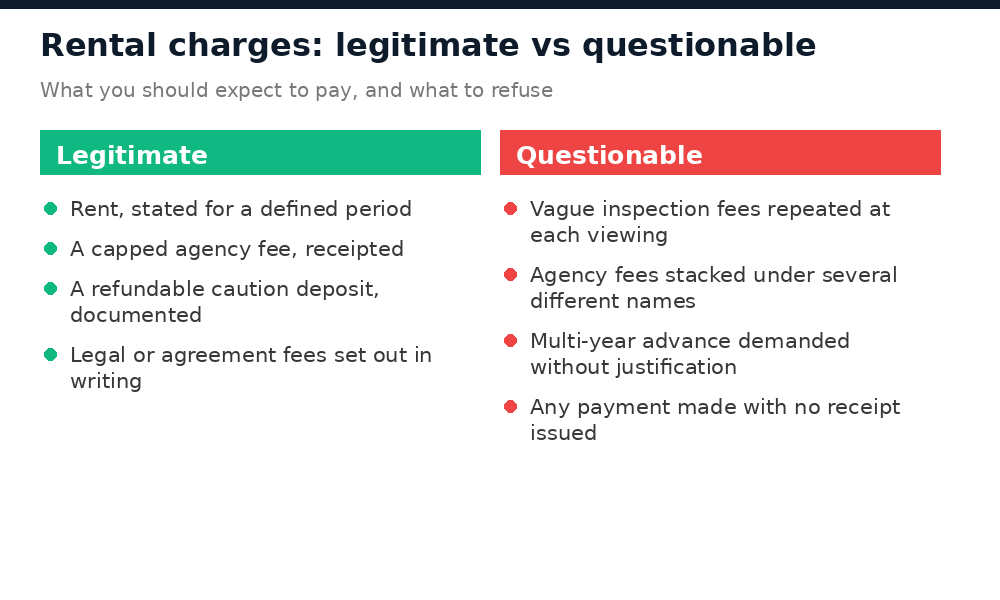
The most common abuse is not one outrageous fee — it is fee stacking. Agency fee, agreement fee, legal fee, inspection fee, caution fee, “commitment” fee: each individually plausible, collectively adding up to a very large multiple of what a capped commission would be.
Your defence is arithmetic. Ask for every charge in writing, with what it covers, before you pay anything. Add them up and compare the total against the rent. If the package comes to a quarter of your annual rent, you are not paying a commission — you are subsidising a business model.
The advance-rent question sits alongside this. Rules capping how much rent can be demanded upfront have already been a live issue in Lagos, and we covered the existing framework in our article on the rent advance payment cap and what it means for you. The new bill would extend that logic with a one-year ceiling written into the tenancy regime itself.
The provision tenants should read carefully
One clause cuts the other way. Under the proposals, tenants seeking legal action against landlords would be required to provide proof of rent payments and updated utility bills before initiating court proceedings.
Read plainly, that is a documentation requirement — and a warning. A tenant who has paid in cash for three years with no receipts, and who has let utility accounts drift, may find the courthouse door harder to push open. Keep every receipt, pay traceably, and stay current on utilities: that is now part of protecting your tenancy, not just good housekeeping.
Where the bill stands
At committee stage, provisions can change: caps can move, obligations can be softened or sharpened. Treat the 5% and the one-year figures as the proposal as presented, not as settled law, and verify the position at the time you sign. What is unlikely to change is the direction of travel — more traceability, more registration, more documentation.
Frequently asked questions
Is the Lagos tenancy bill already law?
No. It was presented on 28 May 2026 and is at committee stage in the House of Assembly. Its provisions may still change before adoption.
What would the agency fee cap be?
The proposed law caps agency fees at 5%. Separately, the state has consistently maintained that estate agency fees in Lagos should not exceed 10% of the total rent payable.
How much advance rent could a landlord demand?
The bill proposes capping advance rent at one year.
Would all estate agents have to register?
Yes. One of the key provisions would make registration with the Lagos State real estate regulatory authority mandatory for all estate agents operating in the state.
How do I verify an agent’s registration?
Ask for the registration details in writing and confirm them directly with the regulator. Do not rely on a photo or screenshot of a certificate, and make sure the registered name matches your receipt and the account you pay into.
What would tenants need before going to court?
Under the proposals, tenants seeking legal action against landlords would have to provide proof of rent payments and updated utility bills before initiating proceedings — which makes keeping receipts essential.
The takeaway
Whether or not the bill passes in its present form, its practical lesson is available now: deal only with an agent you can verify, get every charge in writing before you pay, transfer to an account whose name matches the contract, and keep the receipts. Those four habits neutralise most of what the bill is trying to legislate against.