The renewal message arrives, the number is higher than last year, and you have roughly two weeks to decide. Most tenants do one of two things: accept it because arguing feels pointless, or start hunting for somewhere cheaper on instinct. Both reactions cost money. The decision is more winnable than it looks, and it comes down to a conversation you can prepare for and a calculation you can actually run.
How much have rents actually risen in 2026?
Lagos rents are up 12-18% year-on-year, and some Abuja neighbourhoods are reporting jumps of 40-60%. Those averages hide much sharper individual cases. One tenant in Nyanya, Abuja, saw rent rise 87.5%, from ₦400,000 to ₦750,000. Some Lagos apartments that let for around ₦500,000 a year in 2023 are being quoted at ₦2.5 million in 2026.
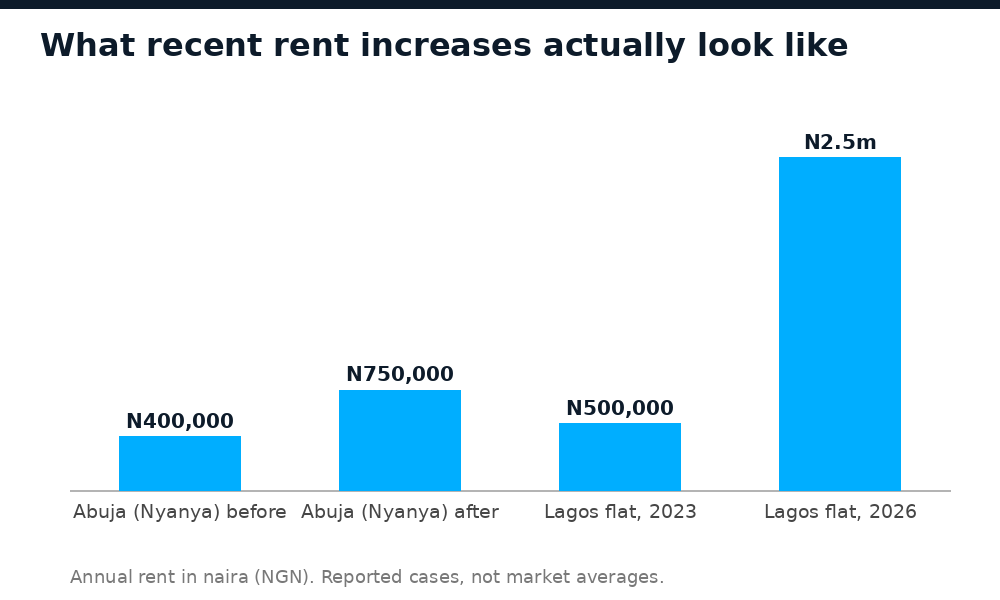
Treat those as reported individual cases rather than market averages — your street may be well below them. But they establish something useful: the range of what landlords are currently asking for is very wide, which means the first number you are quoted is rarely a fixed one.
Why are landlords pushing rents this hard?
Largely because their own replacement costs have moved. Over the same period the naira went from roughly ₦300 to the dollar to about ₦1,400, which repriced everything imported that goes into maintaining and rebuilding a property. A landlord quoting a sharp increase is often not testing you — they are pricing against what the unit would cost to replace or refurbish today.
That matters tactically. An increase driven by real cost pressure is negotiable on terms even when it is not negotiable on principle. Understanding which one you are facing changes what you should ask for.
When should I start the renewal conversation?
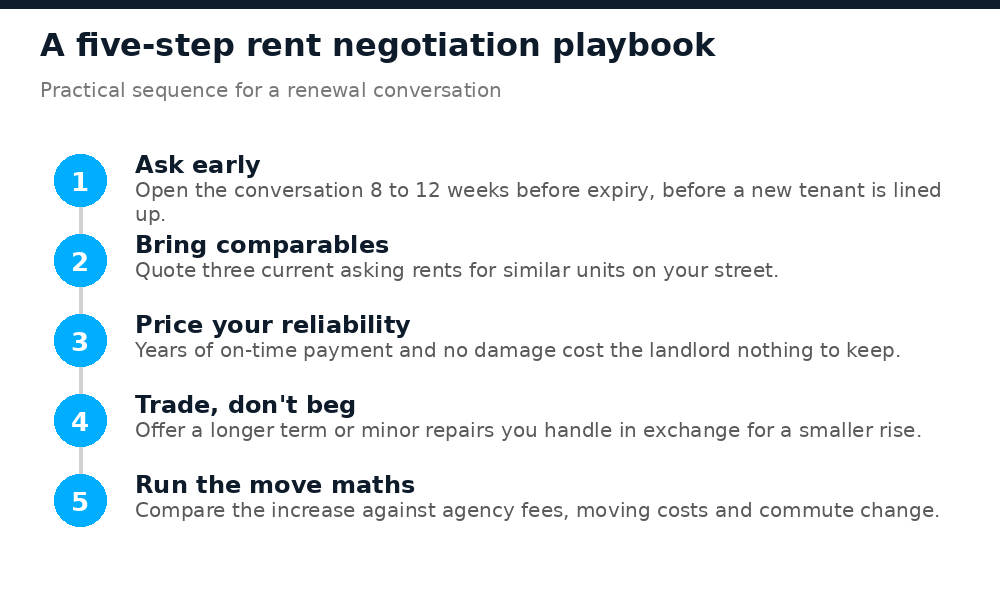
Eight to twelve weeks before expiry, and certainly before your landlord has anyone else lined up. Timing is most of your leverage. A landlord deciding in good time between keeping a reliable tenant and finding a new one is in a very different frame of mind to one who has already had enquiries at the higher figure.
The cost of a vacancy is the argument that does the work here. An empty unit earns nothing while it sits, and re-letting carries its own costs. A landlord weighing a modest reduction against weeks of no income and the uncertainty of an unknown tenant is being offered something genuinely worth having.
What actually works in a rent negotiation?
Evidence and trade-offs work. Complaints do not. Four things move the number in practice:
- Comparables. Find three current asking rents for genuinely similar units nearby — same size, same condition, same street if possible. A landlord quoting well above the local range will usually adjust when shown it, because the alternative is discovering the same thing through an empty unit.
- Your payment record. If you have paid on time for years and left the property in good condition, say so plainly. Reliability has real value to a landlord and costs them nothing to retain.
- Something to trade. A longer commitment, agreeing to handle minor repairs yourself, or flexibility on payment timing are all things a landlord may value more than the last portion of the increase. Offer a trade rather than simply asking for less.
- The condition of the unit. Outstanding repairs are a legitimate part of the conversation. If something has been unaddressed for a while, the renewal is the moment it gets priced in — either fixed, or reflected in the rent.
Keep it in writing where you can, stay courteous throughout, and be clear about what you can actually afford. A tenant who negotiates well and then struggles to pay has not gained anything.
When does moving beat renewing?
When the annual saving clearly exceeds the total cost of moving, and keeps exceeding it in year two. The calculation people get wrong is comparing rent against rent and ignoring everything else. Run it properly:
- The rent difference. New annual rent against the renewal figure — the headline saving.
- Agency and legal fees. Usually quoted as a percentage of annual rent. Check what is standard in the area you are moving to and include every line, not just the agency fee.
- Moving costs. Transport, and whatever the new place needs before it is liveable.
- Commute change. A cheaper unit further out can hand the entire saving to transport costs. Multiply the daily difference by your actual working days before deciding.
- Downtime and disruption. Overlapping rent, time off work, schools, and the practical cost of the move itself.
The rule of thumb worth applying: if the saving does not cover the full cost of moving within the first year, you are usually better off negotiating hard and staying. If it covers it within a few months, moving is the rational choice and you should say so during the negotiation — a landlord who knows you have a credible alternative negotiates differently.
What if the landlord will not move at all?
Then you have a clean decision rather than a bad one, which is worth something. Ask whether the increase can be phased, or whether payment timing can be adjusted — landlords who will not reduce a headline figure will sometimes flex on structure. If nothing moves and the numbers do not work, start looking early rather than under deadline pressure. Rushed moves are where tenants overpay on fees and take units they have not properly inspected.
Whatever you agree, get the final terms in writing before you pay, and keep a record of what was agreed on repairs and duration.
The short version
The first number your landlord quotes is an opening position more often than tenants assume. Start the conversation early, bring comparables, put your payment record on the table, and offer a trade rather than a plea. Then run the moving arithmetic honestly — including fees, transport and commute — because the answer it gives you is also your strongest negotiating position. Staying and moving are both fine outcomes. Accepting a number you never tested is the only bad one.