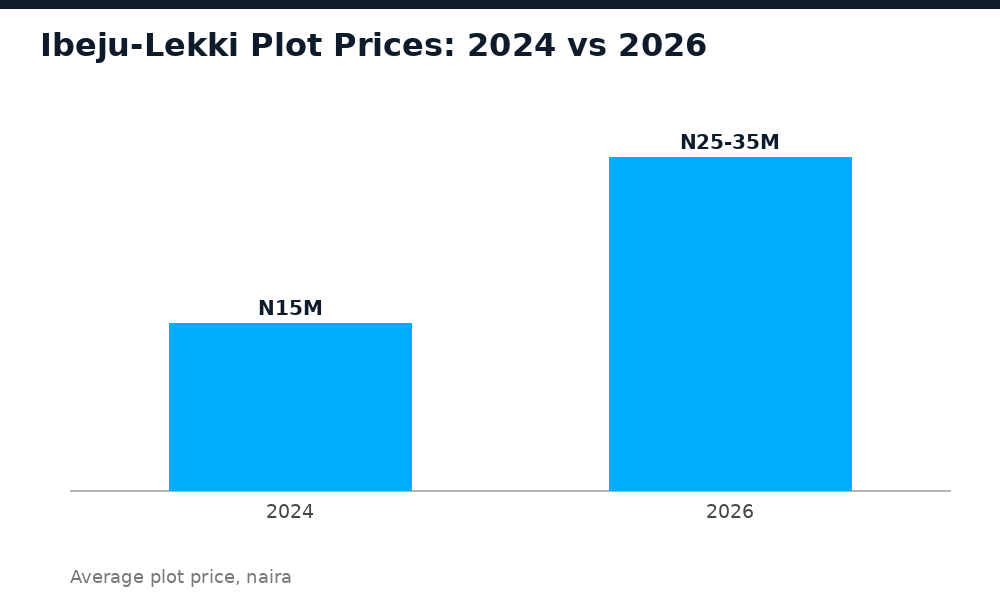
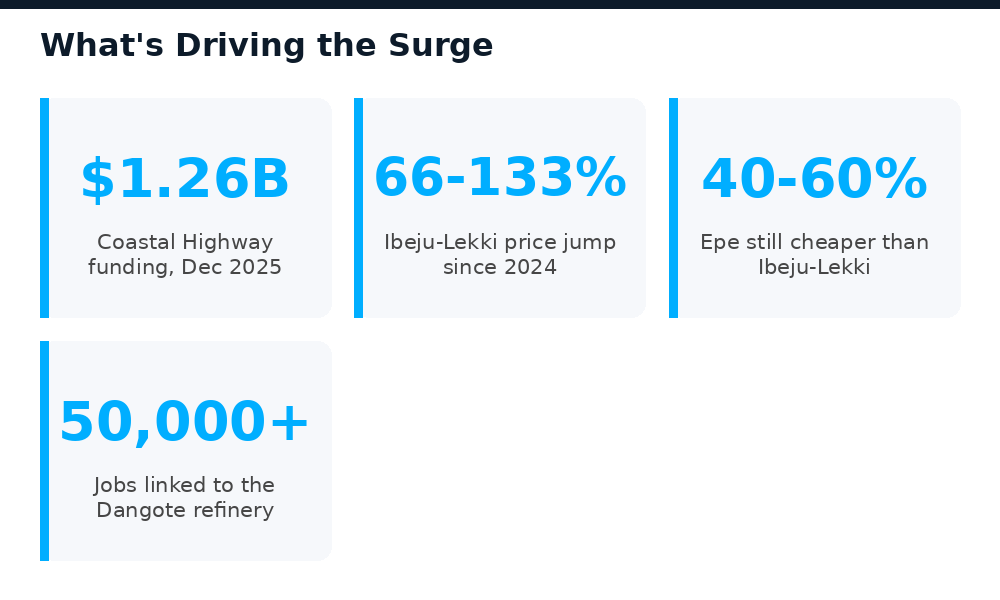
If you looked at land prices in Ibeju-Lekki two years ago and are checking again now, the jump is not a typo. Plots that sold for around ₦15 million in 2024 are now changing hands for ₦25-35 million — a 66% to 133% increase. Meanwhile, next-door Epe remains far cheaper, but is starting to close the gap. Here’s what’s actually driving both markets in 2026.
How Much Have Prices Actually Risen?
The clearest way to see the shift is side by side: the average Ibeju-Lekki plot has roughly doubled in price in two years.
Land closest to the highway corridor is seeing the sharpest premiums — buyers are paying 25-40% more for plots within roughly 5 kilometres of the route compared to areas further inland within the same district. Further out, prices are rising too, just less steeply.
What’s Driving the Ibeju-Lekki Surge?
The single biggest catalyst is infrastructure money. In December 2025, the Eleko-Ode Omi section of the Lagos-Calabar Coastal Highway secured $1.26 billion in funding, and construction on that stretch accelerated through mid-2026. A coastal highway connecting Lagos to Calabar changes the calculation for land along its path: plots that were previously hard to access become commutable, developable, and — for investors — bankable in a way they weren’t before the road existed.
This is a familiar pattern in Lagos real estate: land banking activity tends to spike well before a road is finished, as buyers try to get in ahead of the value the infrastructure will eventually unlock. Ibeju-Lekki, already home to the Lekki Free Trade Zone and the Dangote Refinery complex, was primed for this kind of jump the moment serious highway funding was confirmed.
Why Is Epe Still Cheaper — and Catching Up?
Epe, further along the coast from Ibeju-Lekki, remains 40-60% cheaper for comparable land. Part of that gap is simple geography: Epe is farther from central Lagos and has historically had weaker road access. But the same forces reshaping Ibeju-Lekki are starting to reach it too.
The Dangote refinery, which sits near the Ibeju-Lekki/Epe corridor, is linked to more than 50,000 jobs — a workforce that needs housing, and that housing demand doesn’t stop neatly at the Ibeju-Lekki boundary. As commuting distances stretch and the coastal highway extends the practical reach of the area, Epe is increasingly viewed as the next zone to benefit, at a fraction of Ibeju-Lekki’s current asking price.
Where Should Investors Look Now?
For buyers already priced into the Ibeju-Lekki premium zone near the highway, the trade-off is straightforward: pay more now for land that already has visible infrastructure and refinery-driven demand, with less room left for price appreciation before the highway is fully operational. For buyers looking for more upside, Epe and the outer edges of Ibeju-Lekki — areas that haven’t yet repriced as sharply — carry more construction-timeline risk, but a lower entry cost relative to where prices in the corridor may land once the highway is complete.
Whichever zone you’re considering, verify the title status and any government acquisition or setback notices on a specific plot before committing — rapid price appreciation in a corridor like this tends to attract informal resale chains and disputed titles alongside genuine opportunity.