If you’re planning to sell a house, plot, or apartment in Nigeria in 2026, the tax bill you expect from last year’s rules no longer applies. The Nigeria Tax Act 2025, effective 1 January 2026, scrapped the old flat 10% capital gains tax (CGT) rate for individuals and replaced it with an income-based band system. Here’s what actually changed, and what it means for your sale.
What Changed Under the Nigeria Tax Act 2025?
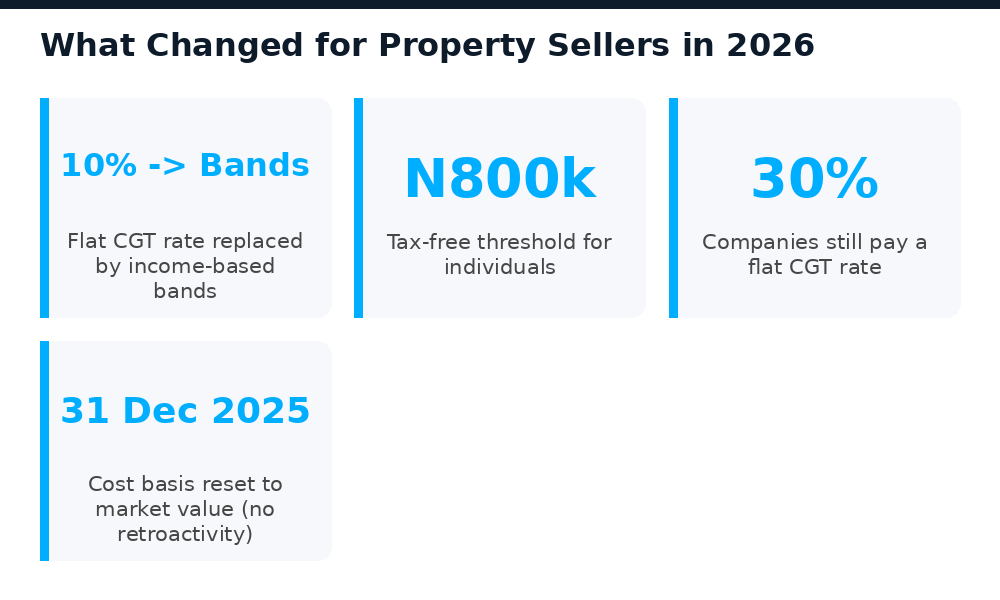
Before 2026, any individual selling a property paid a flat 10% CGT on the gain, regardless of how much they earned elsewhere. Under the new Act, that flat rate is gone for individuals. Instead, capital gains are now stacked on top of your other annual income and taxed progressively, the same logic already used for personal income tax. Companies are not affected by this change — they continue to pay a flat 30% rate on gains.
What Are the New CGT Bands for Individuals?
Once your capital gain is added to your annual income, it falls into one of four bands:
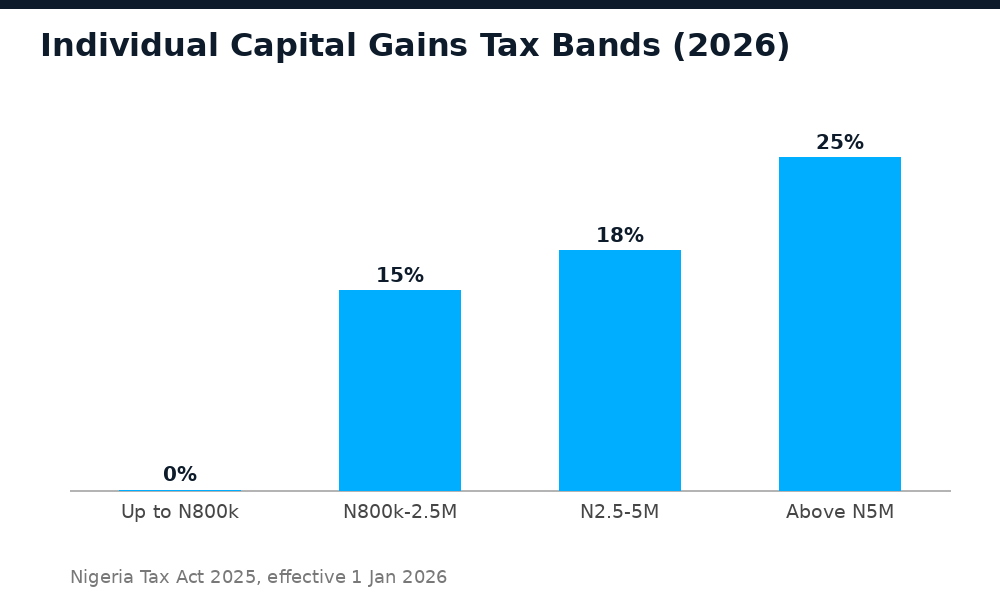
- 0% on the portion of combined income up to ₦800,000
- 15% on the portion between ₦800,000 and ₦2.5 million
- 18% on the portion between ₦2.5 million and ₦5 million
- 25% on the portion above ₦5 million
This is a marginal-band system: only the slice of income falling in each bracket is taxed at that bracket’s rate, not the whole gain at the top rate. A large gain can still push a seller into the 25% band, but the first ₦800,000 of their combined income remains tax-free regardless of the sale.
How Does the Cost Basis Reset Work?
One detail sellers should not overlook: the cost basis used to calculate your gain has been reset to the property’s market value as of 31 December 2025. In practice, this means the new rules are not retroactive — you are not taxed on appreciation that happened before the reform took effect. If you bought a property years ago and its value has since multiplied, your taxable gain for a 2026 sale is calculated from the end-of-2025 valuation forward, not from your original purchase price.
This makes an independent, dated valuation from around that cutoff a useful document to keep on file, especially for older properties where the original purchase price is far below current market value.
What About Companies?
If the property is held by a company rather than an individual — a common structure for larger developers, real estate investment vehicles, or family holding companies — the CGT treatment is simpler and unchanged in principle: gains are still taxed at a flat 30% rate, with no banding. The 2026 reform’s banding system applies specifically to individual taxpayers.
What This Means If You’re Selling in 2026
Before listing a property this year, it’s worth running the numbers under the new bands rather than assuming last year’s flat 10% still applies — for many sellers with moderate gains, the effective rate under the new bands can actually work out lower than 10%, while sellers with large gains stacked on high existing income could end up paying more at the 25% top band. Either way, budgeting your net proceeds around the old flat rate is likely to be inaccurate.
A few practical steps: confirm whether you’re selling as an individual or through a company, gather documentation of the property’s market value as of 31 December 2025 if you’ve held it for several years, and add your expected gain to your other 2026 income to see which band(s) it falls into before agreeing a sale price with a buyer.