Ask most investors about Nigerian real estate and the conversation stops at Lagos and Abuja. Yet Kano — Nigeria’s third-largest city and the historic commercial hub of the north — runs on a real economy of textiles, leather, agro-processing and cross-border trade, with a housing market that has barely been touched by the kind of formal investment flowing into the south. For buyers priced out of Lagos or Abuja, the north is worth a serious look.
Kano at a glance
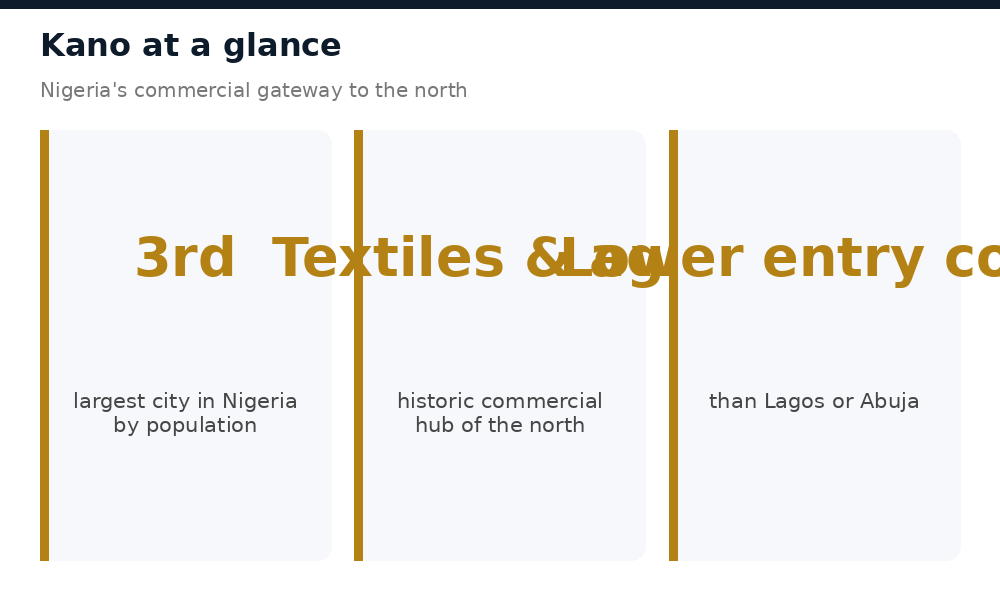
Kano’s economy has never depended on oil or government spending the way Lagos and Abuja’s have. It is built on manufacturing and trade: tanneries and leather goods, textile mills, groundnut and grain processing, and a wholesale market network that reaches across West Africa and into the Sahel. That commercial base supports steady, if less flashy, demand for housing, warehousing and retail space — demand that has not been priced in the way Lagos or Abuja’s has.
How much cheaper is the entry price?
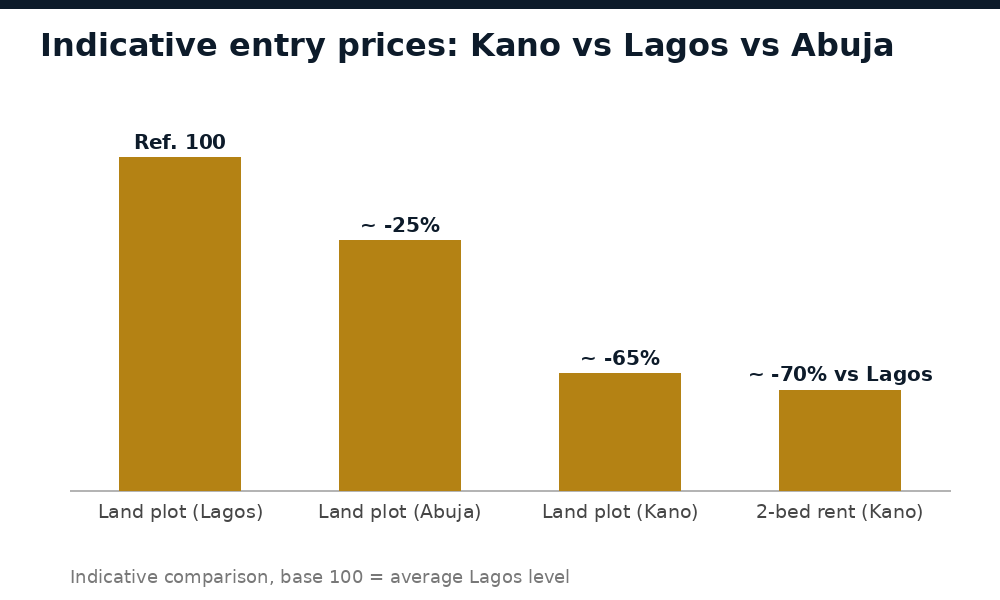
Land and rents in Kano sit well below Lagos levels, and noticeably below Abuja as well. A plot that would command a premium in Lekki or Maitama can be secured in Kano’s growing residential districts for a fraction of the price — a gap that reflects lower demand pressure from diaspora and southern investors rather than any fundamental weakness in the local economy.
Where the demand concentrates
Kano’s commercial core around the old city and the Kano Municipal area remains dense and historic, with limited room for new development. Newer residential growth is concentrated in areas like Nassarawa GRA and expanding districts toward the airport road, where improved infrastructure is drawing middle-class families and returning professionals. Warehousing and light-industrial demand tracks the wholesale markets and the manufacturing corridors on the city’s outskirts.
Investing in Kano and the north: pros and cons
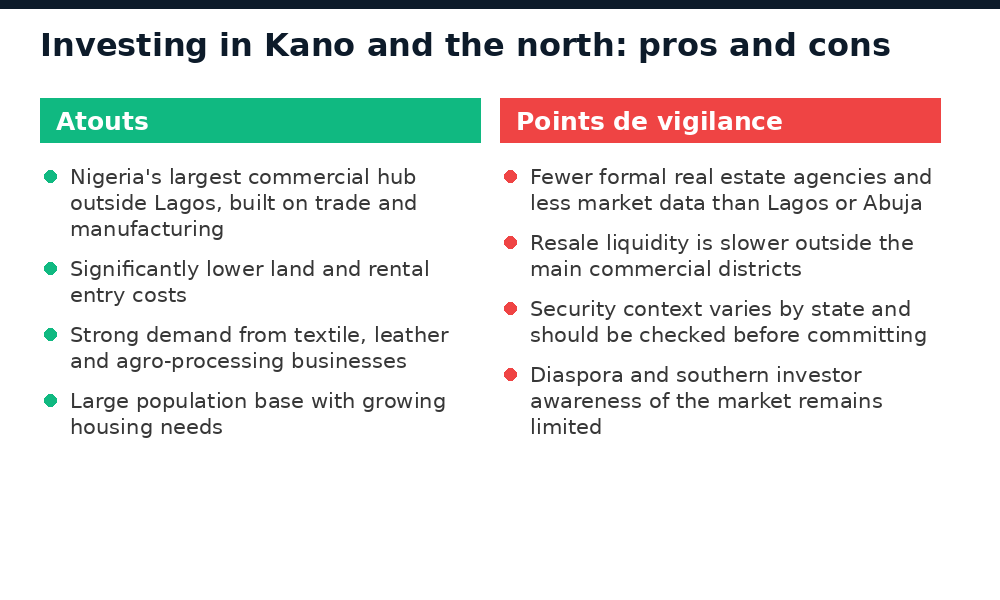
The upside is real: a genuine commercial economy, a large and growing population, and entry prices that leave far more room for appreciation than an already-expensive Lagos plot. The trade-offs are just as real: fewer formal agencies and less published price data make due diligence harder, resale can take longer outside the main commercial districts, and the security context varies by state and by year — always worth checking against current, specific, local information rather than a general impression of “the north.”
Evaluating an opportunity, step by step
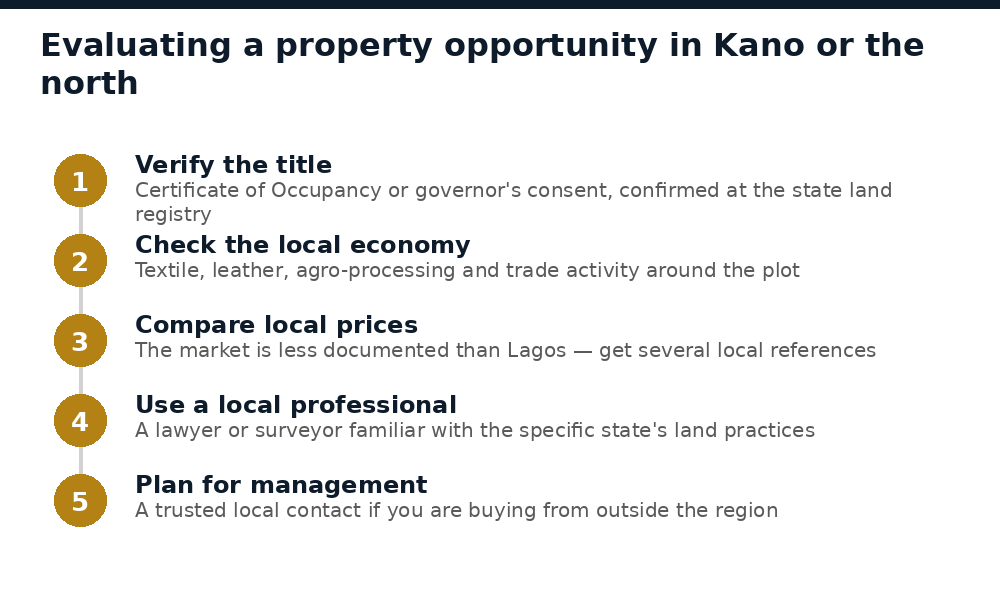
The fundamentals do not change just because the city does. Title verification at the state land registry remains non-negotiable, and it matters even more in a market with less centralized digital infrastructure than Lagos. A local lawyer or surveyor who works the Kano market regularly is worth more than a generic national due-diligence checklist, precisely because state-level land practices and documentation conventions differ across Nigeria.
Who this market suits
Kano and the wider north are not a fit for every investor. They suit buyers with an existing connection to the region, a longer investment horizon, and the patience to work with a smaller pool of formal intermediaries. For diaspora Nigerians originally from the north, or investors looking for a lower-cost entry point into a real, trade-driven economy rather than a purely speculative play, it is a market that rewards those who do the legwork that Lagos investors increasingly take for granted.
The bottom line
Nigeria’s property conversation is overwhelmingly a Lagos-and-Abuja conversation, and that has left Kano and the north under-examined relative to the size of the economy they represent. The opportunity is genuine, but it demands more manual verification and local relationship-building than a Lekki or Maitama purchase — a fair trade for investors willing to put in the work at a meaningfully lower entry price.
This article is general information, not investment advice; verify title and local market conditions with a qualified professional before committing capital.