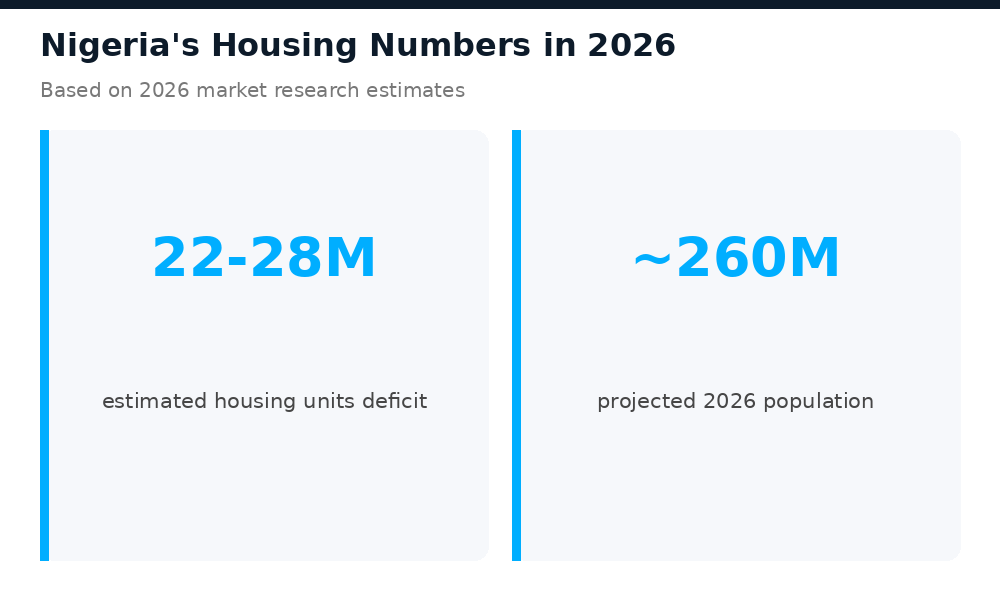
Nigeria enters 2026 with a housing gap most estimates now put at somewhere between 22 and 28 million units, at a time when the national population is projected to approach 260 million. That combination — a fast-growing population and a construction pace that has never kept up with it — is the single biggest structural fact shaping the property market this year, whether you are trying to buy your first home, renew a lease, or decide where to put investment capital.
This isn’t a new problem, but the scale of it in 2026 is worth putting in plain numbers, and worth translating into what it actually changes for someone searching for a place to live or invest right now.
What “22-28 Million Units” Actually Means
A housing deficit of this size means that, even if every current resident already had somewhere to live, Nigeria would still need tens of millions of additional homes to house new households formed by population growth, rural-to-urban migration, and the gradual breakup of large extended-family compounds into smaller independent households. In practice, the deficit is not spread evenly: it is concentrated hardest in Lagos, Abuja and other fast-growing cities, and it bites hardest in the affordable and mid-market segments rather than at the luxury end, where supply has generally kept closer pace with demand.
What’s Driving the Deficit
Four forces are doing most of the work behind these numbers.
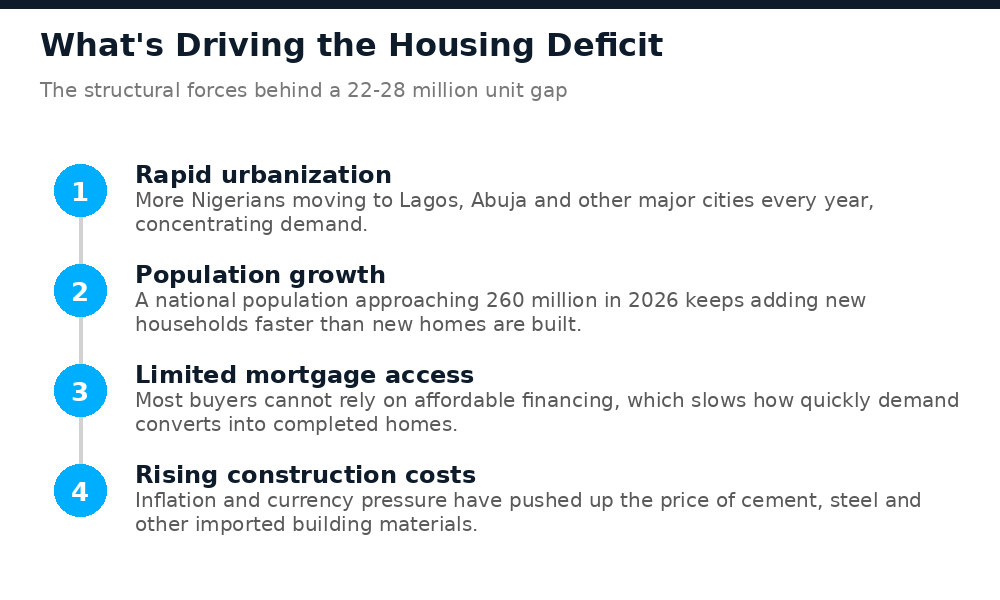
- Rapid urbanization: Nigerians continue moving toward Lagos, Abuja, Port Harcourt and other major urban centers in search of jobs and opportunity, concentrating housing demand in places where land and construction capacity are already stretched.
- Population growth: with the population projected to approach 260 million in 2026, new households are forming every year faster than new housing units are completed.
- Limited mortgage access: without affordable, widely available financing, a large share of demand cannot convert quickly into completed purchases, which slows the market’s ability to absorb the shortfall even where the will and the land exist.
- High construction costs: inflation and currency pressure have driven up the price of cement, steel, roofing sheets and other materials — a large share of which are imported or priced against imported inputs — making it more expensive for developers and self-builders alike to bring new supply online.
What It Means If You’re Renting Today
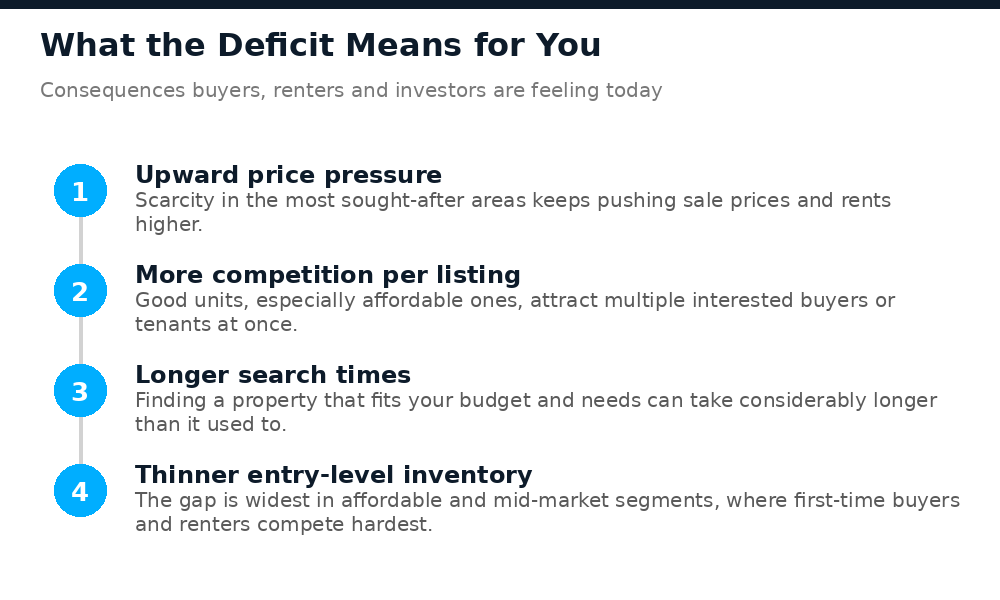
For tenants, a deficit of this size shows up as fewer good options and more competition for each one. Listings in convenient, well-serviced neighborhoods attract multiple interested tenants at once, landlords have less incentive to negotiate on price or terms, and the search itself simply takes longer than it used to. If you are renting in a tight submarket, moving quickly on a well-priced, well-located unit — once you have done the necessary checks — tends to matter more in 2026 than it did a few years ago.
What It Means If You’re Buying
Buyers face a similar dynamic from the other side: sustained demand against constrained supply tends to support prices even during periods when other parts of the economy are under pressure. That makes patience and preparation more valuable than ever — having your budget, your documentation and your legal support lined up before you start seriously searching, so you can move decisively when the right property appears, rather than losing it to a faster-moving buyer.
What It Means for Investors
For investors, a persistent, structural gap between supply and demand is generally a supportive backdrop for well-located property, since it points to durable long-term demand rather than a temporary spike. That said, the same construction-cost pressures pushing up prices for buyers also raise the cost of developing new supply, so investors weighing new-build projects need to budget realistically for materials inflation and currency risk, not just land and finished-unit prices.
Which Segments Feel It Most
The deficit is not uniform. Affordable and entry-level housing is where the gap is widest, because it is the segment most sensitive to construction costs and the one where mortgage access — or the lack of it — matters most. Mid-market family housing in fast-growing urban corridors is also under real pressure. The luxury and prime segments, by contrast, have generally seen supply move more closely in line with the (smaller, higher-income) pool of demand they serve.
Frequently Asked Questions
How big is Nigeria’s housing deficit in 2026?
Estimates put it at roughly 22-28 million housing units, against a national population projected to approach 260 million.
Why does Nigeria have such a large housing deficit?
The main drivers are rapid urbanization, sustained population growth, limited access to affordable mortgage financing, and high construction costs driven by inflation and currency pressure on imported building materials.
Which parts of the housing market are most affected?
Affordable and mid-market housing in fast-growing cities like Lagos and Abuja feel the shortage most acutely. Luxury and prime segments have generally kept closer pace with the smaller pool of demand they serve.
What should buyers and renters do given the shortage?
Prepare your budget, documentation and legal support in advance so you can move quickly on a suitable property, since good options in convenient locations tend to attract competition and move fast.